
The term “menacing” can seem rather, ahem, threatening. But that is exactly what it is.
In Colorado, menacing is when you use threats or actions to make another person fear immediate serious bodily harm or death. It’s about creating a sense of danger even if no harm occurs. Under Colorado Revised Statute § 18-3-206, menacing can be a misdemeanor or a felony depending on if a deadly weapon is involved.
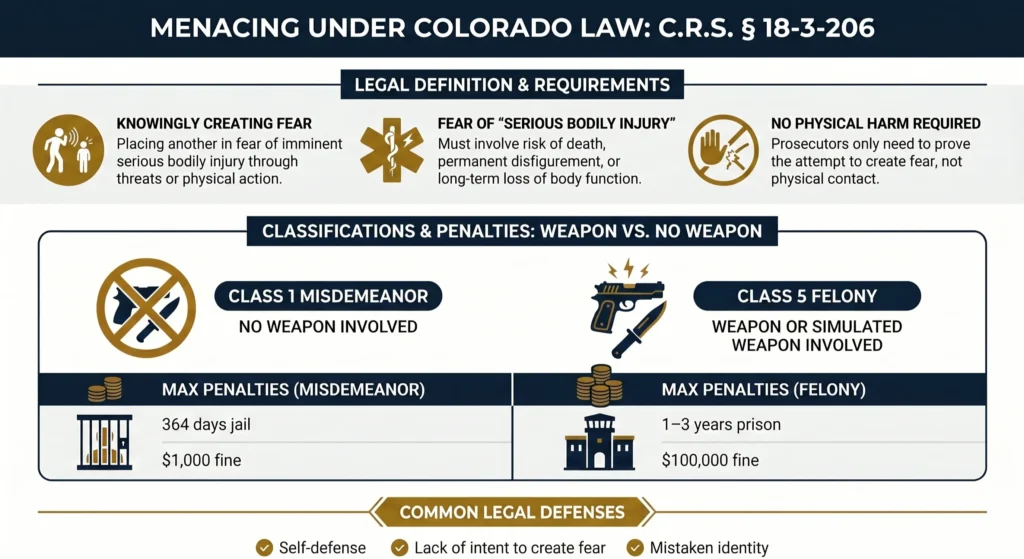
A person commits the crime of menacing if, by any threat or physical action, he or she knowingly places or attempts to place another person in fear of imminent serious bodily injury. Menacing is a class 1 misdemeanor, but it is a class 5 felony if committed by the use of a firearm, knife, or bludgeon or a simulated firearm, knife, or bludgeon.
This article will break down the definition, penalties, defenses, and related charges for menacing in Colorado.
Key Takeaways: Menacing Charges in Colorado
- Menacing Charges in Colorado involve knowingly using threats, actions, or intimidation to place another person in fear of imminent serious bodily injury under Colorado Revised Statute § 18-3-206.
- Menacing can be charged as a Class 1 misdemeanor or a Class 5 felony depending on whether a firearm, knife, bludgeon, or simulated weapon was involved.
- Colorado prosecutors do not need to prove actual physical harm occurred. Creating or attempting to create fear can be enough for a criminal charge.
- Felony menacing convictions in Colorado can lead to prison time, heavy fines, and a permanent criminal record.
- Common legal defenses to menacing charges include lack of intent, self-defense, mistaken identity, and no deadly weapon involvement.
- Menacing charges are often connected with other Colorado criminal offenses such as assault, harassment, domestic violence, stalking, and restraining order violations.
Menacing Definition under Colorado Law
C.R.S. § 18-3-206 says a person commits menacing if they knowingly put or attempt to put another in fear of serious bodily injury. The law requires the offender to create fear through words or actions.
- Misdemeanor Menacing: Menacing without a weapon is a class 1 misdemeanor.
- Felony Menacing: If a firearm, knife or bludgeon (or an object capable of being used as one) is involved, it’s a class 5 felony. This applies even if the weapon is simulated or implied.
The former Menacing statute was much broader about weapons being used. It read “By the use of a deadly weapon or any article used or fashioned in a manner to cause a person to reasonably believe that the article is a deadly weapon; or by the person representing verbally or otherwise that he or she is armed with a deadly weapon.
The second part of the Statute requires, serious bodily injury, also known as “SBI”. The statute defines “serious bodily injury” to include injuries with a risk of death, permanent disfigurement or long-term loss or impairment of body functions.
Menacing Penalties in Colorado
The penalties for menacing depend on if a weapon was involved. Here are the possible consequences:
Misdemeanor Menacing (No Deadly Weapon)
- 364 days in jail
- $1,000 fine
Felony Menacing (Deadly Weapon)
- 1 to 3 years in prison
- $1,000 to $100,000 fine
The court takes the threat seriously even if no harm occurred. Menacing can be charged as a standalone crime, but it is commonly charged with other crimes like assault (1st Degree Assault, 2nd Degree Assault, or 3rd Degree Assault), or harassment.
Is Menacing Considered a Violent Crime in Colorado?
Menacing involves conduct that is intended to place another person in fear of imminent serious bodily injury, so it is often described as a violent or threatening offense. However, the term “crime of violence” has a specific legal meaning under Colorado law and should not automatically be applied to every menacing charge.
Under C.R.S. § 18-1.3-406, Colorado provides special sentencing rules for offenses that meet the statutory definition of a crime of violence. Menacing under C.R.S. § 18-3-206 is not simply classified as a crime of violence because it involves a threat or fear of injury. Other facts and charges may affect whether separate crime-of-violence provisions apply in a particular case.
A menacing charge can still carry significant consequences. Standard menacing is a Class 1 misdemeanor, while menacing involving a firearm, knife, bludgeon, or a simulated version of one of these can be charged as a Class 5 felony.
If a menacing case also involves another offense, such as assault, the legal consequences may be different. The specific charges and circumstances should therefore be reviewed individually.
Key Components of Menacing
To convict someone of menacing the prosecutor must prove:
- Knowingly Creating Fear: The defendant must have known their actions would cause fear.
- Imminent Threat: The fear created must be of immediate or near immediate harm, not a distant or vague threat.
- No Need for Actual Fear: The law only requires the defendant attempted to create fear. The victim’s actual emotional response is not relevant to the charge.
For example, if someone threatens another person with an object hidden from view and claims it’s a weapon, even if the victim doesn’t see the object, it’s felony menacing.
Related: Can Felons Get a US Passport?
What is a Deadly Weapon?
Although the previous iteration of 18-3-206 used the term “deadly weapon,” the current wording in the statute is more specific.
The statute now delineates what a weapon is:
- Firearm
- Knife
- Bludgeon
- Or a simulated firearm, knife or bludgeon
Fake guns or hidden items can be a deadly weapon if the offender leads the victim to believe they are armed with a weapon, or use a simulated weapon.
This is often done with a fake gun or even could be the finger under the shirt made to look like a gun. A bludgeon is typically something similar to a baseball bat, or an item fashioned in a manner that it could be used to beat someone with.
Defenses to Menacing Charges in Colorado
There are several legal defenses to menacing. Each defense attacks the required intent, disproves the weapon or justifies the defendant’s actions. Here are some:
1. No Intent to Create Fear
The prosecution must show the defendant knowingly created fear. If the defendant’s words or actions were misinterpreted or taken out of context this defense could apply. The defense would argue the statements or behavior were not a threat and shouldn’t be criminalized.
2. No Weapon Used
For felony menacing charges the presence or use of a deadly weapon (firearm, knife, bludgeon) must be proven. Remember, the weapon could be simulated or implied.
3. Self-Defense
If the defendant acted in reasonable self-defense menacing may be justified. Colorado law allows individuals to defend themselves proportionally.
4. Mistaken Identity
The person that menaced the alleged victim was another party. If the alleged victim cannot positively identify the accused as the person who menaced them, they may not be able to prove the charges.
Can Menacing Charges Be Dropped in Colorado?
Yes. Menacing charges can sometimes be dismissed or reduced, but there is no guarantee that a charge will be dropped. The outcome depends on the evidence, the circumstances of the alleged threat, and whether the prosecution can prove every required element of the offense.
For example, a menacing charge may become more difficult to prove if:
- There is insufficient evidence that the defendant knowingly created or attempted to create fear.
- Witness accounts are inconsistent or unreliable.
- The alleged threat was misunderstood or taken out of context.
- The evidence does not establish that the defendant was the person who made the threat.
- The prosecution cannot establish the required elements of menacing beyond a reasonable doubt.
- Evidence was obtained in violation of the defendant’s constitutional rights.
In some cases, a defense attorney may challenge the evidence, negotiate for a reduction in charges, or seek dismissal of the case. The specific approach depends on the facts and evidence in the individual case.
Related Offenses
As discussed above, menacing is often times charged with other offenses. It could be charged with an aggravator like Domestic violence, or it could be charged along with other crimes / criminal charges. Menacing often accompanies assault charges, especially in domestic violence cases where emotional intimidation and physical injury occur together.
In my practice, I often times see menacing charges in connection with assaultive behavior.
Three degrees of assault:
- First-degree assault: Causing serious injury with a deadly weapon
- Second-degree assault: Causing injury without a deadly weapon
- Third-degree assault: Negligently causing injury, often with a deadly weapon
Other Colorado offenses overlap or are related to menacing:
- False Imprisonment (C.R.S. § 18-3-303): Restricting another person’s freedom without consent.
- Harassment (C.R.S. § 18-9-111): Repeated unwanted contact, with an intent to harass, annoy or alarm. This could also be through pushing/shoving, or by way of repeated telephone or other electronic means of contact.
- Telephone Obstruction
- Stalking
- Child Abuse
- Sexual assault
- Violation of a Protection or Violation of a Restraining order (C.R.S. § 18-9-803.5)
- Trespass
Related: Understand the Differences Between Assault, Harassment, and Menacing.
Summary
Menacing in Colorado is a serious crime that involves putting another person in fear of imminent serious bodily harm through threats or actions. Whether a misdemeanor or felony menacing carries significant penalties including jail time and fines. If a weapon is involved it can be charged as a felony regardless if the victim saw or was harmed by the weapon.
Understanding menacing is important for both defendants and victims. Intent, context and perception of threat are key to these cases. Defenses can include lack of intent, no weapon or self-defense.
Given the complexity of menacing cases, seeking legal counsel is recommended to navigate the legal process and explore the best possible defenses.
Frequently Asked Questions
What is menacing under Colorado law?
Under Colorado Revised Statutes § 18-3-206, menacing occurs when a person knowingly places or attempts to place another person in fear of imminent serious bodily injury through a threat or physical action. The offense may be charged as a misdemeanor or a felony depending on whether a deadly weapon was involved or the offender claimed to have one.
What is felony menacing in Colorado?
Felony menacing occurs when a person knowingly places or attempts to place another person in fear of imminent serious bodily injury by using a deadly weapon, displaying an object that appears to be a deadly weapon, or representing that they are armed. Felony menacing is a more serious offense than misdemeanor menacing and carries significantly greater penalties.
Is menacing a misdemeanor or a felony in Colorado?
Menacing can be charged as either a misdemeanor or a felony in Colorado. A standard menacing offense is generally a Class 1 misdemeanor, while menacing involving a deadly weapon or the representation of a deadly weapon is typically charged as a Class 5 felony under Colorado law.
What is the Colorado menacing statute (C.R.S. § 18-3-206)?
Colorado Revised Statutes § 18-3-206 defines the criminal offense of menacing. The statute makes it unlawful to knowingly place or attempt to place another person in fear of imminent serious bodily injury. The severity of the charge depends on the circumstances, including whether a deadly weapon was used or displayed.
How serious is a menacing charge in Colorado?
A menacing charge is a serious criminal offense that can result in jail or prison time, fines, probation, and a permanent criminal record. If the offense involves a deadly weapon, it may be prosecuted as a felony, which can have lasting consequences for employment, housing, firearm rights, and other aspects of a person’s life.
Can you go to jail for menacing in Colorado?
Yes. A conviction for menacing in Colorado may result in jail or prison time depending on whether the offense is charged as a misdemeanor or a felony. The court may also impose fines, probation, and other penalties based on the facts of the case and the defendant’s criminal history.
What are the penalties for felony menacing in Colorado?
Felony menacing is generally charged as a Class 5 felony in Colorado. A conviction may result in imprisonment, substantial fines, mandatory parole, and a felony criminal record. The exact sentence depends on the circumstances of the offense and any applicable sentencing enhancements.
What happens if you are charged with menacing in Colorado?
If you are charged with menacing, you may be arrested or summoned to court and required to appear before a judge. The prosecution must prove every element of the offense beyond a reasonable doubt. An experienced Colorado criminal defense attorney can review the evidence, explain your legal options, and work to seek a reduction or dismissal of the charges when appropriate.
Is menacing a violent crime in Colorado?
Yes. Menacing is generally considered a violent offense because it involves knowingly placing another person in fear of imminent serious bodily injury. When a deadly weapon is involved, the offense becomes significantly more serious and may carry felony penalties under Colorado law.
What is the difference between menacing and threatening?
Menacing and threatening are different criminal offenses under Colorado law. Menacing generally requires knowingly placing or attempting to place another person in fear of imminent serious bodily injury, while threatening offenses may involve different conduct or legal elements depending on the applicable statute. The facts of each case determine which charge, if any, applies.
Can menacing charges be dropped?
Yes. Menacing charges may be dismissed or reduced if the evidence is insufficient, witnesses are unreliable, constitutional rights were violated, or the prosecution cannot prove every element of the offense beyond a reasonable doubt. Whether charges can be dropped depends on the specific facts and legal issues involved.
How can you defend against a menacing charge?
The best defense depends on the circumstances of the case. Possible defenses may include lack of intent, self-defense, defense of others, mistaken identity, false accusations, or insufficient evidence. An experienced criminal defense attorney can evaluate the facts and determine the most appropriate legal strategy.
What is menacing with a deadly weapon?
Menacing with a deadly weapon occurs when a person knowingly places or attempts to place another person in fear of imminent serious bodily injury by using, displaying, or representing that they possess a deadly weapon. Under Colorado law, this conduct is generally charged as felony menacing and carries more severe penalties than misdemeanor menacing.
What Is an Example of Aggravated Menacing in Colorado?
“Aggravated menacing” is not the standard name of the offense under Colorado’s menacing statute. Colorado law refers to the offense as menacing under C.R.S. § 18-3-206. The charge can become a Class 5 felony when the menacing is committed using a firearm, knife, bludgeon, or a simulated firearm, knife, or bludgeon.
For example, suppose a person points what appears to be a firearm at another person and knowingly attempts to make that person believe they are about to suffer serious bodily injury. If the object qualifies as a firearm or simulated firearm under the statute and the other elements of menacing are established, the conduct may support a felony menacing charge.