
A lot of people tend to use the terms “burglary” and “robbery” interchangeably; however, these types of crimes have very different elements. While these offenses are often confused in everyday conversation, they are separate crimes under Colorado law, each carrying distinct legal definitions, required elements, and penalties.
In this post we’ll cover the differences between burglary and robbery in Colorado, explore the elements of each offense, and examine how aggravating factors like the use of weapons or harm to victims can elevate the severity of these charges.
Burglary vs Robbery: Quick Summary
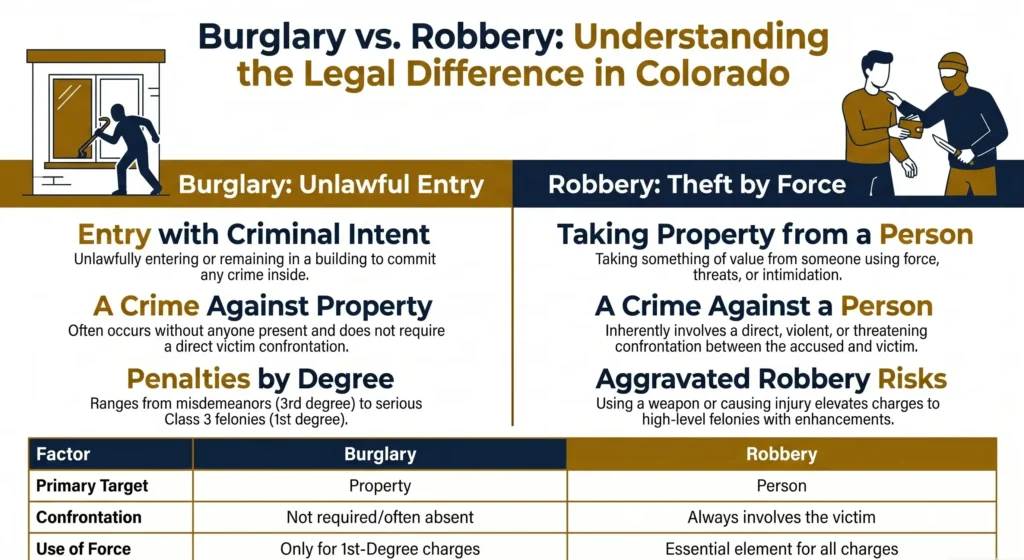
- Burglary is unlawfully entering a building with intent to commit a crime inside, while robbery is taking property from a person using force or threats.
- Burglary is considered a crime against property, whereas robbery is a crime against a person.
- Robbery always involves confronting a victim directly; burglary often happens without anyone present.
- Force or intimidation is central to robbery, but not required for most burglary charges.
- Both can be serious, but robbery with its violent elements often carries harsher sentencing than burglary.
Burglary in Colorado: Unlawful Entry with Criminal Intent
Definition: Under Colorado law, burglary is defined as unlawfully entering or remaining in a building or structure with the intent to commit a crime therein (not limited to theft). The statute governing burglary can be found under C.R.S. § 18-4-202 through 18-4-204, covering different degrees of burglary.
It’s important to note:
- Burglary is primarily a crime against property, although it may also involve risk to persons if violence occurs.
- The underlying crime intended inside the premises can be theft, assault, vandalism, or any other offense.
Degrees of Burglary
- Third-Degree Burglary (C.R.S. § 18-4-204):
- Occurs when a person breaks into or unlawfully enters a vault, safe, cash register, or similar equipment.
- Common in cases involving tampering with ATMs or vending machines.
- Third degree burglary is a class 2 misdemeanor, but it is a class 1 misdemeanor if it is a burglary, the objective of which is the theft of a controlled substance.
- Second-Degree Burglary (C.R.S. § 18-4-203):
- Involves unlawfully entering or remaining in a building or occupied structure with the intent to commit a crime.
- Class 4 felony generally, but it ranges from a Class 3 felony to a Class 2 misdemeanor, depending on the circumstances/facts. It becomes a Class 3 felony if:
- The offense occurs in a dwelling (home burglary),
- The intent is to steal controlled substances,
- Or the target is a pharmacy or other place with drugs.
- Penalties can include 4–12 years in prison and fines up to $750,000.
- Second degree burglary is a class 2 misdemeanor if the person knowingly violated a written notice by a retailer or an order by a court of lawful jurisdiction specifically restraining a person from entering a particular retail location during hours which the retail store is open to the public.
- First-Degree Burglary (C.R.S. § 18-4-202):
- The most serious burglary charge.
- Occurs when, during the act of burglary:
- The defendant assaults or menaces any person,
- Or is armed with explosives or a deadly weapon.
- Class 3 felony, punishable by 4–12 years in prison, and potentially more if aggravators apply (e.g., violent crime enhancer).
Aggravating Factors in Burglary
- Use or possession of a weapon,
- Assault or menacing during the burglary,
- Targeting of homes, pharmacies, or locations with controlled substances,
- Prior convictions for similar offenses.
Robbery in Colorado: Theft by Force or Threat of Force
Definition: Robbery, by contrast, is a crime against a person. It involves taking property from someone by using force, threats, or intimidation. The applicable statute is C.R.S. § 18-4-301 through 18-4-303.
Unlike burglary, robbery requires direct confrontation between the accused and the victim — it is inherently violent or threatening in nature.
Types of Robbery
- Simple Robbery (C.R.S. § 18-4-301):
- Taking anything of value from another person by the use of force, threats, or intimidation.
- Class 4 felony, punishable by 2–6 years in prison and fines up to $500,000.
- Aggravated Robbery (C.R.S. § 18-4-302):
- Involves the use of a deadly weapon, or if the defendant represents verbally or through actions that they are armed.
- Can also apply if an accomplice is armed, or if the defendant wounds or strikes the victim during the robbery.
- Class 3 felony, an extraordinary risk crime, and carries mandatory sentencing enhancements under Colorado’s violent crime statutes.
- If the weapon is discharged or serious bodily injury results, penalties increase substantially.
Aggravating Factors in Robbery
- Use or display of a weapon (even an unloaded one),
- Threats of deadly force,
- Causing injury to the victim,
- Targeting of vulnerable victims or drug facilities,
- Robbery as part of organized crime.
Comparing Burglary and Robbery: Key Differences
| Factor | Burglary | Robbery |
| Type of Crime | Crime against property | Crime against person |
| Definition | Unlawful entry with intent to commit a crime inside | Taking property from a person using force or threat |
| Direct Confrontation | Not necessarily (often occurs when no one is present) | Always involves confrontation with victim |
| Use of Force | Only required for first-degree burglary | Force or intimidation is an essential element |
| Common Locations | Homes, businesses, pharmacies, safes | Public places, streets, homes, or businesses (if victim is present) |
| Penalties | Misdemeanor or Felony, up to 12+ years with aggravators | Felony, up to 24+ years with aggravators |
Why the Distinction between Burglary and Robbery Matters?
The difference between burglary and robbery is more than just semantics — it can have a major impact on how a case proceeds through the criminal justice system in Colorado.
- Sentencing Enhancements: Robbery charges, especially aggravated robbery, often come with mandatory prison time due to Colorado’s sentencing laws for violent crimes.
- Defense Strategies: Defending against burglary charges often hinges on challenging the intent to commit a crime inside the property, while robbery defenses may focus on contesting the use of force or ownership of the property.
- Restitution and Victim Impact: Both charges will typically involve restitution. Because robbery involves direct victims, courts may order restitution for physical harm in addition to stolen property. Robbery is a crime that falls under Colorado’s Victim Rights Act (VRA). First Degree Burglary also is a VRA crime.
Final Thoughts
Facing burglary or robbery charges in Colorado is a serious matter. Both crimes carry felony penalties and the possibility of significant prison time, especially when weapons or violence are involved. However, understanding the differences between these offenses is the first step toward building an effective legal defense or making informed decisions in your case.
If you or someone you love has been charged with burglary, robbery, or any related offense in Colorado, it is crucial to consult with an experienced criminal defense attorney. Early intervention can make the difference between a favorable outcome and the harshest penalties the law allows. Give us a call at 719-227-0022, or contact us for a free consultation to discuss your case.
Frequently Asked Questions
What is burglary domestic violence?
Burglary is not automatically considered a domestic violence offense in Colorado. However, it may receive a domestic violence designation if the alleged burglary is committed against a current or former spouse, intimate partner, family member, or someone with whom the accused has had an intimate relationship.
For example, unlawfully entering an ex-partner’s home with the intent to commit a crime could result in burglary charges with a domestic violence designation. A conviction may carry additional consequences, including mandatory treatment requirements and restrictions on firearm ownership.
Is burglary considered a violent crime?
Burglary is generally classified as a property crime because it involves unlawfully entering a building or occupied structure with the intent to commit a crime inside.
However, some burglary offenses can be treated as violent crimes. For example, first-degree burglary involves aggravating factors such as assaulting or threatening another person or being armed with a deadly weapon during the offense. These circumstances can result in more severe penalties than a typical burglary charge.
What are considered property crimes?
Property crimes involve unlawfully taking, damaging, or entering another person’s property without permission. Common property crimes in Colorado include:
- Burglary
- Theft
- Criminal mischief
- Trespassing
- Motor vehicle theft
- Arson
Unlike robbery, property crimes generally do not require the use or threat of force against another person. However, depending on the circumstances, some property crimes can be charged as serious felonies.
What does being mugged mean?
Being “mugged” generally means someone has taken your property by using force, threats, or intimidation. While “mugging” is a common term, it is not a separate criminal offense under Colorado law.
Instead, conduct commonly described as mugging is typically charged as robbery or aggravated robbery, depending on the facts of the case.
What’s considered a violent crime?
A violent crime is an offense that involves the use, attempted use, or threatened use of physical force against another person. Common examples include robbery, aggravated robbery, assault, homicide, kidnapping, and certain burglary offenses involving weapons or violence. Whether an offense is classified as a violent crime can significantly affect sentencing and other legal consequences.
Why is robbery considered a violent crime?
Robbery is considered a violent crime because it requires taking property directly from another person through the use of force, intimidation, or threats.
Unlike burglary, which typically involves unlawfully entering a structure, robbery places the victim in immediate fear of harm or involves actual physical force. This direct confrontation with the victim is why robbery is generally punished more severely than burglary.
What is a Class 3 felony?
A Class 3 felony is one of the more serious felony classifications under Colorado law. Several offenses, including first-degree burglary and aggravated robbery, may be charged as Class 3 felonies depending on the circumstances.
A conviction can result in substantial prison time, significant fines, and long-term consequences such as the loss of certain civil rights and difficulty obtaining employment or housing. The exact penalties depend on the offense and whether sentencing enhancements apply.
What is aggravated robbery?
Aggravated robbery is a more serious form of robbery that involves additional aggravating factors, such as being armed with a deadly weapon, knowingly putting the victim in fear of death or serious bodily injury, or using force while attempting to take property. Because aggravated robbery poses a greater risk to victims, it carries significantly harsher penalties than simple robbery under Colorado law.
What is second-degree burglary?
A person commits second-degree burglary in Colorado by knowingly and unlawfully entering or remaining in a building or occupied structure with the intent to commit a crime against a person or property.
The severity of the charge depends on factors such as the type of property involved and the intended crime. Burglary of a dwelling or burglary involving controlled substances or firearms generally results in more serious felony charges.
What is more serious: robbery or burglary?
In many cases, robbery is considered more serious because it involves the use or threat of force against another person. Burglary is generally a property crime involving unlawful entry into a building or structure with the intent to commit a crime inside.
However, certain burglary offenses, such as first-degree burglary involving a deadly weapon or assault, may carry penalties comparable to or greater than some robbery charges. The seriousness of either offense ultimately depends on the specific facts of the case and the applicable Colorado statute.