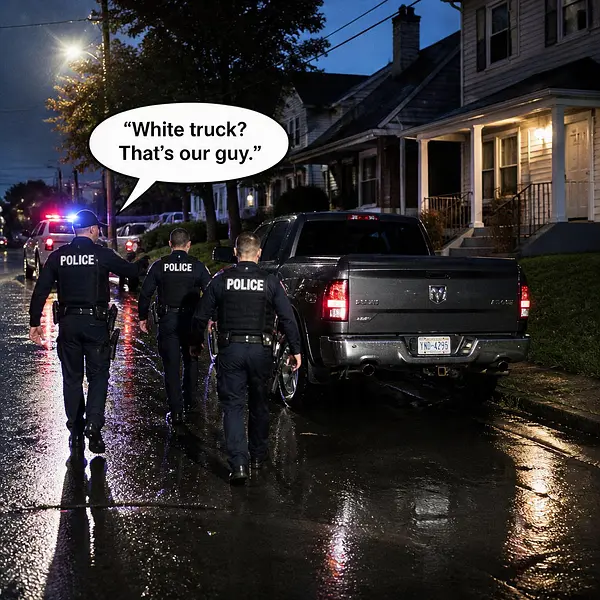

You drive through a neighborhood on your way to an appointment. A camera records your license plate. A few days later, an officer shows up at your house and accuses you of theft.
You know you did nothing wrong. The officer is convinced otherwise.
How does that happen? And what can you do when the police put more confidence in their surveillance methods than the evidence explaining why you were there?
I have handled criminal cases in Colorado Springs for more than 20 years, first as a Deputy District Attorney and since 2007 as a criminal defense attorney. Technology can help investigators find evidence. But the questions an attorney needs to ask remain familiar: What does the evidence actually show? How did police obtain it? What did they overlook?
License plate readers, facial recognition and predictive policing raise different legal issues. They also create a common concern. Are increased surveillance techniques and computer algorithms infringing on our constitutional rights and protections?
A Colorado Woman Accused of a Theft She Did Not Commit
In September 2025, a police officer accused Denver resident Chrisanna Elser of stealing a package in nearby Bow Mar. According to The Colorado Sun’s reporting, the officer relied on Flock cameras showing her Rivian in the area, and his claimed identification of her in doorbell footage.
Elser offered to show him video from her truck. He issued a summons anyway.
She then assembled location records, vehicle video, and surveillance images from the business where she had an appointment. On October 15, the police chief told her the summons had been voided. Great work by Chrisanna, but an ounce of police work would have saved a woman from having to prove her innocence for the police to realize their error.
Denverite later reported that the officer would face discipline. The town defended his initial belief that a summons was justified, while Elser said she had spent days trying to get police to review her evidence.
An accusation like this creates problems even when it eventually goes away. You may have a court date, concerns about your job and the expense of defending yourself. Elser had records that helped establish where she was. Another person might have far less available.
When Facial Recognition Identifies the Wrong Person
In 2020, Detroit police arrested Robert Williams at his home in front of his family after a false facial recognition match connected him to a shoplifting investigation. He was not the person in the surveillance image.
His lawsuit resulted in a 2024 settlement requiring changes to Detroit’s use of facial recognition. Those changes included restrictions on arrests and photo lineups based on facial recognition leads.
Police photo lineups can be suggestive when used inappropriately. Police must have independent, reliable evidence linking a person to the crime before placing that person in a lineup based on such a lead.
That requirement addresses a basic investigative problem. If software identifies the wrong person, putting that person into a photo lineup does not necessarily correct the mistake. It can create another identification built on the same flawed starting point.
An attorney reviewing the case needs to examine how police selected the suspect in the first place, as well as what happened afterward.
I’ve personally handled shoplifting cases where police charged the wrong person based on mistaken identity. The city attorney sent me video of a gentleman stealing from Sears. This was 15 years ago, and the camera quality wasn’t great, but I could tell immediately that the person on camera wasn’t my client.
It’s a long story as to how/why they fingered my client as the perpetrator, but ultimately it boiled down to lazy police work. It took the city attorney being willing to watch the video with my client sitting in front of him. I told the prosecutor, “It’ll take 5 minutes. That’s better than doing it in front of a jury…” He started writing up the dismissal 10 seconds into the video.
Predictive Policing in Pasco County
The Pasco County, Florida, litigation involved a different use of technology: identifying people considered likely to commit future crimes and repeatedly visiting them and their families.
According to the Institute for Justice, which represented the residents, deputies used these visits to pursue violations involving matters such as tall grass and missing house numbers. Children were among those placed on the agency’s list.
The December 2024 settlement provided $105,000 for four plaintiffs and a commitment not to resume the discontinued program or a substantially similar process of designation and repeated, suspicionless visits.
The agreement acknowledged visits that exceeded officers’ implied permission to approach a home and interfered with family association and liberty interests. Note: It also expressly denied liability and noted that the court had not found the written policies unconstitutional on their face.
This was a settlement addressing a particular program and its application to these families. It was not a nationwide ruling that every form of predictive policing violates the Constitution.
The Constitutional concern is still substantial, and so is the invasive police behavior. Predicting that someone might commit a crime does not give police unlimited authority to intrude on that person’s home or family.
When Officers Misuse Surveillance Records
Sometimes the concern is deliberate misuse of a system that recorded the information correctly.
In March 2026, The Marshall Project reported that former Milwaukee officer Josue Ayala had pleaded not guilty to attempted misconduct in public office. Prosecutors alleged that he used a license plate reader system more than 170 times over roughly two months to look up a woman he was dating and her former boyfriend.
This reported conduct illustrates why access controls matter. A database created for criminal investigations can also reveal information about someone’s personal life. In this instance we don’t have institutional abuse, but allegations of personal abuse of the system, by a law enforcement officer. The information collected by these cameras gave an individual access to information that could substantially impact the privacy and/or safety of others. I’m curious to know the defense in this case, as I don’t see any good or legal reason why anyone needs to track their ex’s (or their current boyfriend’s) location.
Safeguards should be applied. Limited access. Tracking of access of all records to include the person’s name accessing the recordings. Attached case number establishing the reason for the search to verify it was a request with a lawful purpose. In the same report, Flock said its audit logs cannot be altered and can help establish when officers misuse the system. That is a useful safeguard. Departments still need to review those records and act on unauthorized searches.
The public should be able to ask who has access, what justifies a search and how violations are detected.
What Does the Fourth Amendment Protect?
The Fourth Amendment protects against unreasonable searches and seizures. Applying that protection to location databases requires courts to examine how the government obtained the information and what the technology reveals.
In Carpenter v. United States, 585 U.S. 296 (2018), the Supreme Court held that obtaining the historical cell-site location records at issue was a search. The government generally needed a warrant supported by probable cause.
The Court recognized that a detailed record of your movements can reveal private information about your life. Keeping that information with a wireless carrier did not eliminate the constitutional protection. Are we all carrying around little snitches in our pockets that keep track of more information than we think about? Are police going to try and collect that information? You better believe it.
Our phones are not only internally tracking our movement, they are also sending information out to that is being collected. Quick defense attorney note: If you’re out committing crimes, consider leaving your phone at home.
Carpenter was also a limited decision. It did not resolve every question involving cameras, public movements or digital records.
In Chatrie v. United States, decided June 29, 2026, the Court addressed Google location data obtained through a geofence warrant. That process began with an area and time near a robbery, then narrowed the users whose information police sought. Police could access cell tower information showing the numbers of every phone that pinged off a tower in that area at that time. That’s a pretty wide net.
The Court held that obtaining Chatrie’s location data was a Fourth Amendment search. It rejected the argument that his use of Google’s Location History eliminated his reasonable expectation of privacy.
But finding a “search” is only part of the analysis. The Court returned the case for consideration of whether the warrant met probable cause and particularity requirements.
It also left the good-faith exception unresolved.
The decision did not declare every geofence warrant unconstitutional or automatically exclude the evidence against Chatrie.
Are License Plate Readers Unconstitutional?
There is no single answer that covers every camera network and every use of its records.
In Schmidt v. City of Norfolk, a federal district court ruled for the city on January 27, 2026. The opinion stated that the plaintiffs’ vehicles had been photographed approximately 475 and 325 times during four and a half months in early 2025.
The court concluded that the record did not establish that Norfolk’s system captured the whole, or nearly the whole, of a person’s movements. The litigation concerned the collection and retention of the plaintiffs’ vehicle data; police had not queried their vehicles in the system.
The plaintiffs appealed. Their briefs and the district court’s decision are available on the case’s document page. This will likely continue to be litigated in different jurisdictions and fact patterns. At what point does the collection of information become a search? And where do we have an expectation of privacy? Do we have an expectation on public roads that our movement won’t be tracked and uploaded over extended periods?
Can a Risk Score Affect Sentencing?
In State v. Loomis, 2016 WI 68, the Wisconsin Supreme Court considered a challenge to COMPAS, a proprietary risk assessment used during sentencing.
Loomis argued, in part, that the confidential scoring method prevented him from evaluating its accuracy. The court allowed consideration of the assessment subject to restrictions and written cautions.
Those restrictions were more than a suggestion to be careful. The court said the risk scores could not determine whether the defendant was incarcerated or the severity of the sentence. Other factors had to independently support the sentence. Many jurisdictions use a version of a pre-sentence investigation to review criminal history, mental health, substance abuse, community support etc. to determine if the defendant is a good candidate for probation, community corrections, or prison. Are the judicial system’s reliance on a proprietary computer system recommendations misplaced when the algorithm is proprietary? Is it unreasonable to want to see it’s work on the calculus that recommended my client serve a prison sentence?
Loomis was a Wisconsin sentencing case involving someone already convicted. Admittedly, this is very different from authorizing police to arrest people for predicted future crimes, but it feels like a pinky toe in the shallow end of using computers to determine a person’s fate. What about AI judges and juries? 12 different computers listening to the facts to decide if the evidence meets the burden of beyond a reasonable doubt? Proponents will argue that AI is already much better than humans at processing information, and it would save countless man-hours away from life and work.
I can’t see anyone seriously arguing for that.
Not yet.
What the UK and China Show About Government Surveillance
In the United Kingdom, police use CCTV footage, automatic license plate readers and facial recognition to investigate crimes and identify suspects. The UK Home Office explains that officers can compare faces recorded on CCTV against police photographs.
Live facial recognition goes further, scanning people passing a camera and comparing their faces against a watchlist. You do not have to be suspected of a crime for your face to be scanned. The Home Office says biometric data is immediately deleted when there is no match, and an alert alone does not justify an arrest.
China shows how surveillance can reach into ordinary daily behavior. In Xinjiang, Human Rights Watch documented a police system that combined information from surveillance cameras and other sources to identify people for investigation.
Authorities treated lawful conduct, including avoiding the front door or not socializing with neighbors, as suspicious. Then what? What do they do about this concerning behavior? Do we trust the Government to use this information for a legal purpose? And what is a lawful purpose for collecting that information? Why are they keeping data about noncriminal behavior to profile and possibly impact people’s freedoms? Could that happen here?
China’s “social credit” system raises related concerns, but it requires an accurate description. As MERICS explains, China does not operate the single nationwide score for every citizen often described in popular accounts. Its system includes different regulatory records, blacklists and local initiatives. The consequences can still be significant. China’s own Supreme People’s Court reports that court-imposed restrictions on judgment can prevent purchases of airline and high-speed rail tickets.
Are we headed towards this big brother-esque system where constant surveillance yields judgments by an AI system that says whether a person is likely to commit crimes? Or is a higher risk to board a plane? Traditional credit scores tell lenders whether an individual is a good credit risk to repay their loan; is a social credit system reliable to tell us whether an individual is more or less likely to commit a crime?
The UK and China have very different legal systems and protections. But both examples give us concrete questions to ask about surveillance here: What information is collected? Who can search it? What consequences follow? And if the government gets it wrong, how do you challenge it?
We aren’t just talking about foreign governments; we also have our own history of expanding surveillance in the name of national security. After September 11, Congress passed the USA PATRIOT Act, broadening the government’s ability to obtain personal records, including information about U.S. citizens.
The government used Section 215 as authority to collect telephone records in bulk, including records of Americans who were not suspected of terrorism. These were records about calls, rather than recordings of the conversations, but information about whom you call and when can still reveal private relationships.
The USA FREEDOM Act ended that bulk collection program in 2015. The Patriot Act also expanded the FBI’s use of national security letters to obtain certain telephone, financial and credit records without prior court approval. Those requests could reach people who were not themselves the subjects of an investigation, provided their records met the applicable national security relevance standard.
A Justice Department inspector general review documented serious misuse of that authority. That history matters when we discuss surveillance today. A national security purpose does not guarantee that only dangerous people will be monitored, that information will be collected lawfully, or that oversight will catch mistakes before someone is harmed.
What Should Happen When Technology Points at You?
Technology is improving so quickly that the courts will be required to keep up with new (and often devious) methods of data collection. Cameras with facial recognition and license plate readers are becoming increasingly common. There are 15 Flock cameras in a shopping center I frequent. I know because I looked it up for this post.
https://deflock.org/
That’s staggering to think about the amount of data they are collecting on visitors to the area. Who is putting these cameras up? Law enforcement, municipalities, and even HOAs are installing these cameras to track and record information about residents.
You might ask, “But Josh, why are you worried about cameras if your clients aren’t doing anything wrong?” If you’re asking that, go back and read this post again. Innocent people have been wrongly accused because officers misidentified them or drew the wrong conclusions from surveillance records. Your car being near a crime does not mean you committed it. Your face resembling a suspect does not make you that person.
There is also the issue of privacy. Where you worship, which doctor you visit and who you spend time with can reveal personal information you have every reason to keep private. These systems can also be abused by officers tracking someone for personal reasons.
And when police get it wrong, you may face an arrest, legal bills and damage to your reputation before the mistake is corrected. You should not have to wait until you are falsely accused to care about how the government collects and uses information about you.
As a defense attorney, I would want to examine the original images and records, their timestamps, how investigators identified the suspect, and any evidence that contradicts their theory. I would also want to determine whether police obtained the information lawfully.
If you believe location records or video could help your defense, preserve what you have promptly. Keep the original files. An attorney can help identify other records to request and address retention deadlines. Elser’s case shows why evidence that explains your movements can matter.
For a broader discussion of searches and police authority, see my article on Colorado search, arrest and warrant laws.
I also favor stronger limits on access to surveillance databases, documented reasons for searches, meaningful audits, and procedures that allow defendants to examine technology used against them.
Police should verify an identification and investigate evidence accordingly. A prosecutor should ask whether the evidence supports the charge. A defense attorney should challenge both the reliability of the evidence and the way it was obtained. Did law enforcement use information from a camera to develop probable cause? Or did an algorithm review movements and patterns to invent it?
AI video creation is getting so good that sometimes I have to really pay attention and consider what I’m seeing on a screen to determine if it’s real. Social media is a cesspool of AI slop that is getting more realistic/believable every day. Five years from now? I doubt even a trained eye will be able to tell the difference on many videos.
Today I have constitutional concerns about the government keeping track of its citizens’ movements, the potential to unlawfully search and seize information from our cars and phones, and abuse of collected information. Tomorrow it might become predictive policing.
Are we on the slippery slope of Minority Report, where instead of psychic “precogs”, we have AI and algorithms determining who has committed, or even will commit, a crime? Ask Chrisanna Elser, Robert Williams, or the people of Pasco about how this future looks. It’s here, and it’s happening.