A no-contest plea and a guilty plea almost always lead to the same place: a conviction and a sentence. The difference is what you say on the record. With a guilty plea, you admit the charge. With a no-contest plea (also called nolo contendere), you don’t admit guilt, but you give up your right to a trial and the judge sentences you as if you were guilty. In Colorado, you also can’t simply choose no contest. The court has to agree to it.
If you are staring at a plea offer right now, take a breath. This is a decision you make with a lawyer, not alone at the first hearing. Below, we explain how the two pleas compare, why the label matters less than most people think, and what to review before you enter either one.
People v. Darlington, 105 P.3d 230 (Colo. 2005). The Colorado Supreme Court said that, for purposes of the criminal case, a nolo contendere plea is “fully equivalent” to a guilty plea. It also identified the key distinction: nolo gives the defendant the advantage of not being estopped from denying fault in a civil action arising from the same facts.
This article is general information about Colorado practice, not advice on your specific case.
Table of Contents
Key takeaways
-
Both pleas waive your trial. Neither one keeps the prosecution’s burden of proof in play. Only a not-guilty plea does that.
-
Both ordinarily result in a conviction. Cornell’s Legal Information Institute explains that a no-contest plea doesn’t expressly admit guilt but still waives trial and lets the court punish you as though you were guilty.
-
In Colorado, no contest requires the court’s consent. Colorado Criminal Rule 11 says so directly.
-
The biggest practical difference is usually civil. A no-contest plea may keep the plea itself from being used against you in a related lawsuit. It does not make the conviction disappear.
-
Don’t pick a plea by its label. Look at the sentence, the collateral consequences and the rights you give up.
What a guilty plea means
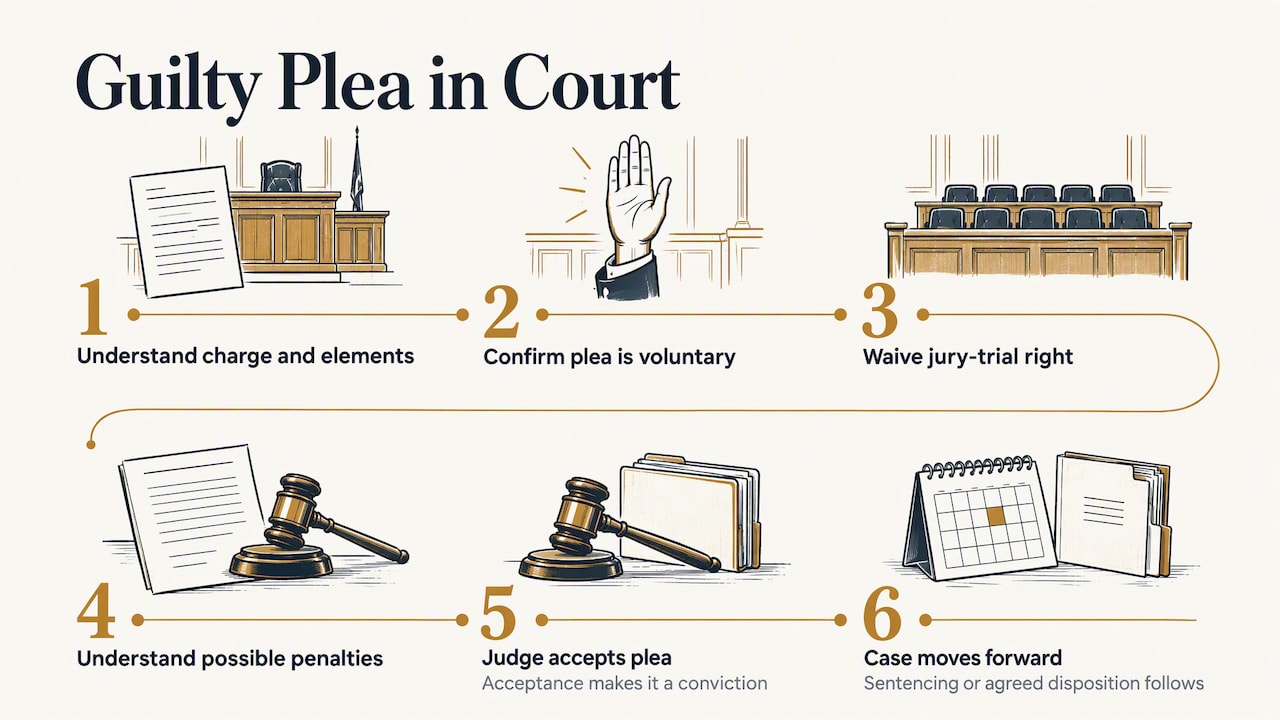
When you plead guilty, you tell the court you committed the offense charged. The judge then asks you a series of questions to make sure the plea is knowing and voluntary. Under Colorado Rule 11(b), the court may not accept a guilty or no-contest plea until it determines, among other things, that you understand the charge and its elements, that the plea is voluntary, that you are waiving your right to a jury trial, and that you understand the possible penalties. The same rule also tells defendants that the court is not bound by what anyone has told them about the penalty.
That last point matters. A prosecutor’s recommendation, or even a negotiated agreement, doesn’t always lock in the sentence in the way people assume. We go through exactly what is and isn’t binding in your particular agreement before you ever stand up in court.
Once the judge accepts a guilty plea, that is a conviction. The Colorado Judicial Branch glossary defines a conviction to include a judge’s acceptance of a guilty plea, not just a verdict after trial. The case then moves to sentencing or to whatever disposition was agreed.
What a no-contest plea means
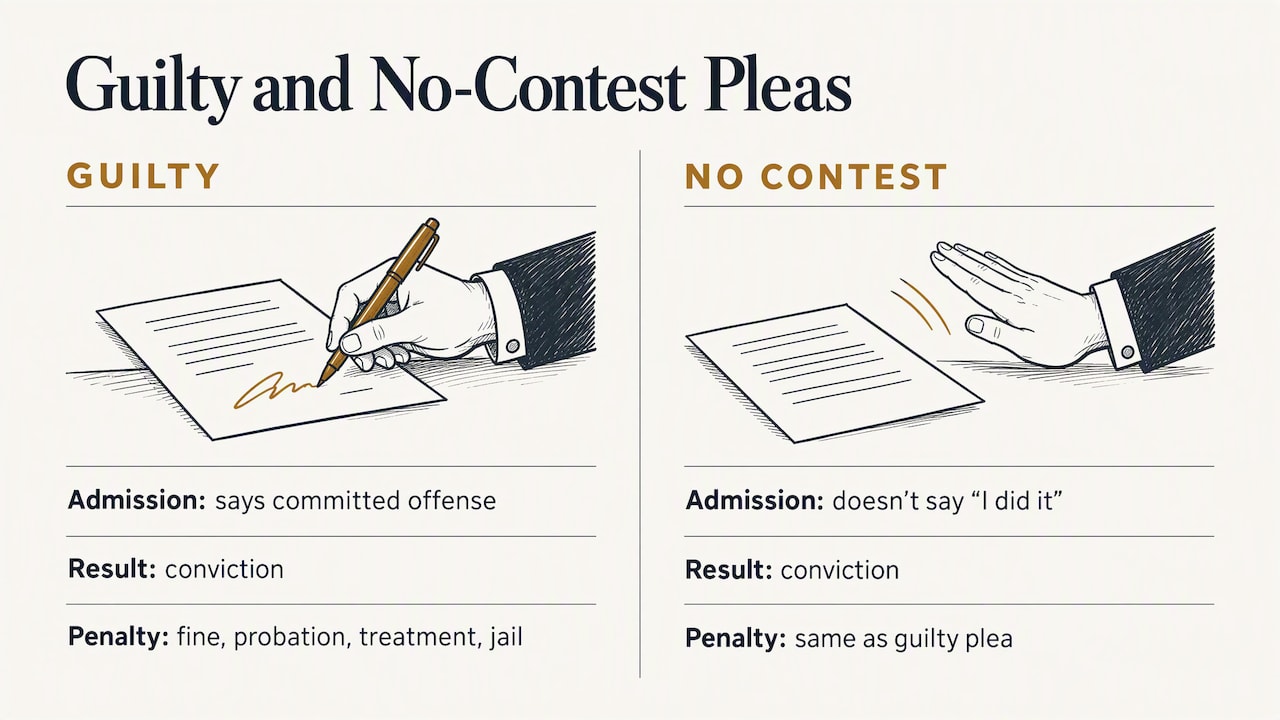
Nolo contendere is Latin for roughly “I do not wish to contend.” You are telling the court you won’t fight the charge. You don’t say “I did it,” and you don’t say “I didn’t.”
If you’re asking whether no contest is the same as guilty, the honest answer is: for punishment, yes. The federal rule says that for sentencing purposes nolo contendere is treated like a guilty plea, and the resulting judgment is a conviction. Colorado courts follow the same practical logic. You can be fined, placed on probation, ordered into treatment or sent to jail, just as with a guilty plea, if the offense carries those penalties.
It is also not the same as pleading not guilty. A not-guilty plea keeps the case going toward discovery, motions and possibly a trial. A no-contest plea ends that path.
Side-by-side comparison
| Question | Guilty plea | No-contest plea | Not-guilty plea |
|---|---|---|---|
| Do you admit the offense? | Yes, expressly | No express admission | No |
| Do you waive trial rights? | Yes | Yes | No |
| Is there a conviction? | Yes | Yes | Only if later convicted |
| Can the judge sentence you as if guilty? | Yes | Yes | Only after a guilty verdict or later plea |
| Does the court have to consent? | Court must find the plea valid | Colorado requires the court’s consent | No |
| Typical civil-case effect | The plea may be used against you | The plea itself generally cannot be used as an admission | Nothing admitted |
The row that causes the most confusion is the last one. We will come back to it.
Colorado: the judge has to agree
People often assume no contest is a menu option like any other. In Colorado, it isn’t. Rule 11(a) allows a defendant to plead guilty, not guilty, not guilty by reason of insanity, or, with the consent of the court, nolo contendere.
That has real consequences for planning:
-
A prosecutor’s agreement is not enough. Even if the district attorney’s office is fine with a no-contest plea, the judge can decline.
-
You need a fallback. If the judge refuses, you may be asked to choose between guilty and not guilty on the spot. We prepare for that possibility before the hearing, including whether to proceed with a not-guilty plea and litigate motions.
-
Federal court works similarly. Federal Rule 11 allows nolo contendere only with the court’s consent, after the judge considers the parties’ views and the public interest in effective administration of justice.
If you are in El Paso County, how often and in which types of cases judges accept no-contest pleas varies. Ask your lawyer what is realistic in the courtroom where your case is set, not what happened in a case someone read about online.
Why people consider no contest
The most common reason has nothing to do with the criminal sentence. It is a civil lawsuit.
Suppose a crash results in a criminal charge, and the other driver is also thinking about suing. A guilty plea is an admission. The other side may want to use it in the civil case to show you were at fault. Colorado Rule of Evidence 410 addresses this: as written, it makes evidence of a nolo contendere plea inadmissible in a civil or criminal proceeding against the person who made the plea, “except as otherwise provided by statutes of the State of Colorado.” That copy of the rules is several years old, so your lawyer should confirm the current text and any statutory exceptions that apply to your claim.
The federal rules reflect the same reasoning, and Cornell’s reference notes that this protection is narrow. It limits using the plea as an admission. It does not erase:
-
the underlying incident and the other evidence about it,
-
the injuries and damages someone may claim,
-
the criminal conviction itself, which may remain relevant later,
-
testimony you give in the criminal case, which can raise impeachment issues in a later proceeding.
So no contest is a litigation strategy. It isn’t a finding that you’re innocent, and it isn’t a promise of lighter punishment.
What no contest does not do
Here are the misunderstandings we hear most often.
“No contest means no conviction”
It doesn’t. As discussed above, the judgment is a conviction. Be careful with shorthand like this, because the word “conviction” can mean different things under different laws. A Colorado appellate decision summarized by the legislature’s legal staff, in its Cases of Note, held that a successfully completed DUI deferred judgment, which the DUI statutes expressly exclude from the definition of “conviction,” was still a conviction for purposes of the record-sealing statute. The same disposition counted differently under different statutes. That is why we ask, every time, which law is asking the question: the DMV, a licensing board, an employer, an immigration agency, or a sealing statute.
“No contest is an easy way out of a DUI”
No. In a DUI case, the plea label doesn’t remove DUI-related consequences. Probation terms, classes, fines, jail exposure and license consequences depend on the charge, the agreement and the sentence. If you want the specifics, see our guide to Colorado DUI, DWAI and UDD penalties and our explanation of license suspension after a DUI.
“The judge will go easier on me”
Not automatically. Judges don’t treat the plea label as a discount. What shapes the sentence is the offense, your history, the agreement and the facts presented. Rule 11 itself warns that the court is not bound by representations about the penalty.
“I can take it back later”
Withdrawing a plea after the court accepts it is difficult and has its own standards. Treat entering a plea as the point of no return, and get your questions answered first.
Why an innocent person might plead no contest
It is one of the most common questions, and it makes people uncomfortable, so here is a direct answer. Some people facing a charge they dispute still weigh a plea offer, because trial carries risk. A conviction at trial can mean a harsher sentence than the offer. An offered disposition may include probation instead of jail. A civil claim may be waiting in the wings. A no-contest plea lets someone resolve the case without saying words they say aren’t true.
That is a serious tradeoff, and it should be made with full information about the evidence, not out of fear or exhaustion. If you believe you didn’t commit the offense, the first question is whether the case can be defended, through suppression motions, weaknesses in the evidence or other defenses. A plea should come after that review, not before.
What is an Alford plea?
An Alford plea is a guilty plea entered by a defendant who continues to maintain innocence. Instead of admitting that the prosecution’s allegations are true, the defendant accepts a guilty plea because the evidence creates a substantial risk of conviction at trial and the plea offer is preferable to that risk. Colorado recognizes Alford pleas, and once the court accepts one, it is treated as a guilty plea and results in a conviction. That makes an Alford plea different from a no-contest plea. With no contest, the defendant does not admit guilt and does not enter a guilty plea. With an Alford plea, the defendant does enter a guilty plea, even while maintaining that he or she did not commit the offense. The distinction can matter in later civil, licensing, immigration, and other proceedings, so the consequences should be reviewed carefully before choosing either option.
A different option to consider: deferred judgment
Sometimes a better question than “no contest or guilty” is whether the case can be resolved in a way that lets the charge fall away if you complete conditions. In Colorado, a deferred judgment and sentence may allow that in some cases. Eligibility and the terms depend on the charge and the court, and the DUI context has its own quirks, as the case above shows. Our page on deferred judgment and sentence in Colorado covers the benefits and eligibility in more detail. A deferred judgment usually involves a plea at the start, so the plea decision and the deferral decision are linked.
What to review before entering any plea
Use this as a checklist for the conversation with your lawyer. These are the issues Colorado practice requires you to understand before the court accepts a plea.
-
The exact charge and sentencing range. Is it a misdemeanor or a felony? Are there mandatory minimums?
-
The evidence. In a DUI case that means the officer’s observations, body camera video, breath or blood results and witnesses. Was the stop lawful? Was testing done properly? Our article on how to get criminal charges dropped in Colorado explains how motions and weaknesses in a case can change the picture.
-
Collateral consequences. These include employment, professional licenses, insurance, firearm rights, housing and immigration status. Non-citizens in particular should have an immigration review before any plea, whatever it is called.
-
Civil exposure. Is anyone injured, or likely to sue? Will the plea be used in a later case?
-
The terms of the deal. Will there be probation, treatment, restitution, fines, an interlock requirement or jail? What happens if you violate probation?
-
Whether the court will accept it. If you’re asking for no contest, what is the plan if the judge says no?
-
The alternative. What does a not-guilty plea give you? That plea keeps the prosecution’s burden of proof in place and keeps motions and trial available.
The Colorado Judicial Branch’s rights summary says it is wise to use your constitutional rights even if you later decide to plead guilty. Those rights include remaining silent and speaking with a lawyer. In practice, that means you shouldn’t explain what happened to police, a prosecutor, an insurance adjuster or the other side of a possible lawsuit until you’ve had legal advice about your case.
Worked example: a crash, a charge and a possible lawsuit
This is a hypothetical, not a real client.
A driver is charged with careless driving causing injury after a collision. The other driver has said they are considering a claim. The prosecutor offers a disposition with a fine and probation. The defense lawyer reviews it and sees three questions.
First, does the offered sentence make sense given the evidence? If the case has real defense issues, maybe the answer is to litigate. Second, if the driver accepts the offer, which plea is available? A guilty plea is an admission that the other driver’s lawyer may try to use. Third, would the court consent to no contest, and does the prosecutor object? If the court won’t, is the driver willing to take the guilty plea, or would they go forward on not guilty?
None of that answers “which is better” in the abstract. It shows why the answer depends on the facts. Our page on careless driving causing injury in auto accident cases walks through how these overlapping criminal and injury issues arise.
How we approach the plea decision
Josh McDowell is a former prosecutor, and he keeps a limited caseload so he can personally handle each case. When a client comes to us with a plea offer, we look at the evidence first and the label second. We want you to understand what you give up, what you receive, and what the realistic alternatives are, in plain language, before you decide.
If you’re facing a charge in Colorado Springs or El Paso County, you can learn about our criminal defense representation or, if your case involves a DUI or DWAI, our DUI defense practice. We can discuss your charge and your options, and you don’t need to have decided anything before you call. If you’d like to talk privately first, see whether we offer confidential online consultations.
No lawyer can promise a result. What we can promise is that you’ll have the facts and a plan before you stand in front of the judge.
FAQ
Is no contest the same as guilty?
For sentencing, yes. The court can impose the same penalties, and the case ends in a conviction. The difference is that a no-contest plea doesn’t expressly admit guilt, which can matter in a related civil case.
Is it better to plead no contest or not guilty?
They do different things. A not-guilty plea keeps the case alive: you stay presumed innocent, and the prosecution must prove guilt beyond a reasonable doubt. A no-contest plea gives up that trial. Which is better depends on the evidence, the offer and your risks, so discuss it with a criminal defense lawyer before the hearing.
Can I choose to plead no contest in Colorado?
Not on your own. Colorado Rule 11 allows nolo contendere only with the court’s consent. Your lawyer should find out in advance whether the prosecutor and judge are likely to agree, and prepare a backup plan if they don’t.
Does a no-contest plea protect me in a civil lawsuit?
Partly. Under the rules of evidence, the plea itself generally can’t be used as an admission against you. But the conviction, the underlying facts, and your testimony can still matter. Have a lawyer check the Colorado rules and statutes that apply to the specific claim.
Is a no-contest plea better for a DUI?
Not as a rule. The label doesn’t remove DUI penalties, license consequences or a record. The sentence and the terms of the agreement matter far more. Ask a Colorado DUI lawyer to review the evidence and the offer together based on your situation.
Sources
Some Additional Reading:
-
Deferred Judgment and Sentence in Colorado: Benefits, Eligibility
-
What Happens when someone presses charges against you in Colorado