If you’ve been arrested for DUI in Colorado, you may have only seven days to protect your driver’s license.
And I’m not talking about your criminal case.
In Colorado, a DUI arrest can trigger two completely separate proceedings. One happens in criminal court, where the prosecutor must prove you committed a crime. The other happens at the DMV, where the government can take away your driving privileges even if you are never convicted of DUI.
I’ve been handling DUI cases in Colorado Springs for over 20 years, first as a prosecutor and now as a criminal defense attorney. One of the first things I look at when someone calls me about a DUI is the status of their driver’s license.
That’s because you can have a strong criminal defense and still lose your license if you fail to act.
Here’s what you need to know about Colorado DMV hearings, how to request one, what happens during the hearing, and what you can do if the DMV revokes your license.
What Is a DMV Hearing After a DUI in Colorado?
A Colorado DMV hearing is an administrative proceeding to determine whether the state can revoke your driver’s license following an alcohol-related driving arrest.
It’s commonly called an Express Consent hearing or a DUI per se hearing.
The hearing is conducted by the Colorado Department of Revenue, not the criminal court.
This distinction matters.
In your criminal DUI case, the prosecutor must prove guilt beyond a reasonable doubt.
At the DMV hearing, the burden of proof is much lower. The hearing officer generally needs to find that the statutory grounds for revocation have been established by a preponderance of the evidence.
That means more likely than not.
You can lose your driver’s license at the DMV even if the prosecution ultimately dismisses your criminal DUI charge or a jury finds you not guilty.
The two proceedings are independent under C.R.S. § 42-2-126(6)(a).
I’ve seen people focus entirely on their criminal charges while overlooking the DMV proceeding. That’s a mistake.
If your goal is to protect your driver’s license, you need to address both cases.
For an overview of how these proceedings interact, see my article on whether you will lose your license after a DUI in Colorado.
How Long Do You Have to Request a DMV Hearing?
In most Colorado DUI cases, you have seven calendar days after receiving your Notice of Revocation to request a DMV hearing.
Not seven business days.
Seven calendar days.
However, when the deadline starts depends on whether you took a breath test, submitted to a blood test, or refused chemical testing.
If You Took a Breath Test
If you submitted to a breath test and the result was .08 or higher, the arresting officer will generally confiscate your driver’s license and provide an Express Consent Affidavit and Notice of Revocation.
Your seven-day deadline begins when you receive that notice, ordinarily on the day of your arrest.
The paperwork generally serves as a temporary driving permit during that initial period, assuming you were otherwise legally authorized to drive.
If you want to challenge the revocation, you must request a hearing before the deadline expires.
If You Took a Blood Test
Blood tests work differently.
Unlike breath testing, blood samples must generally be sent to a laboratory for analysis. The results often take a few months.
Because the officer ordinarily does not have a blood alcohol result at the time of arrest, the DMV revocation process may not begin until the laboratory reports the result.
If the result supports a per se revocation, the DMV will mail you a Notice of Revocation.
The notice will have a date by which you must request the hearing, usually about 7-10 days out.
Make sure the DMV has your current mailing address. An important notice sent to an old address can create serious problems.
If You Refused a Chemical Test
If an officer determines that you refused a required chemical test under Colorado’s Express Consent law, the officer will generally confiscate your license and provide a Notice of Revocation immediately.
You ordinarily have seven calendar days from receiving that notice to request your hearing.
Refusing a test has consequences beyond the DMV hearing. A first refusal carries a one-year revocation if sustained, and a refusal can result in a Persistent Drunk Driver designation. Remember, you are likely eligible for early reinstatement as long as there are no other hold/revocations/suspensions in place.
You can read more about the testing requirements and consequences of refusal in my article on Colorado’s Express Consent laws.
How Do You Request a Colorado DMV Hearing?
The easiest way to request a hearing is through the Colorado DMV’s online system.
Go to myDMV.colorado.gov and select the option to request a hearing under the appointments and hearings section.
The Colorado Department of Revenue also recognizes requests made through certain DMV offices and written requests submitted through authorized channels.
However, because the deadline is so short, I recommend using a method that provides confirmation of your request.
You need to actually request the hearing.
You should also save the confirmation and copies of anything you submit.
The Department of Revenue maintains additional instructions on its DMV Administrative Hearing Process page.
Should You Request the Arresting Officer’s Presence?
When requesting your hearing, you’ll have an important decision to make.
Do you want the arresting officer to appear?
In my experience, having the arresting officer testify can be valuable in many cases. In some cases, it may be valuable to not have the officer fill in holes in their report. I have won DMV cases where I saw the officer left off a necessary element (such as the time of the blood draw, or the time of driving), and the revocation is dismissed for lack of evidence.
The hearing gives your attorney an opportunity to question the officer under oath about the arrest, the investigation, chemical testing procedures, and other details.
Those answers can also be useful when preparing the criminal case as well.
But there are strategic considerations. An attorney may have reasons to proceed without the officer’s testimony in a particular case.
Under C.R.S. § 42-2-126(7), if you request the officer’s presence when initially requesting the hearing, the Department must issue the appropriate notice requiring the officer to appear.
If you don’t request the officer initially, you may need to obtain and serve a subpoena later.
A subpoena requiring a law enforcement officer to appear must be served at least five calendar days before the hearing.
I generally recommend discussing this decision with a DUI defense attorney before submitting the hearing request, if time permits.
What Happens if You Miss the Seven-Day Deadline?
If you fail to request the hearing within the required period, you generally waive your right to challenge the administrative revocation through that hearing process.
The DMV’s determination becomes final, and the revocation takes effect.
There are limited exceptions.
Under C.R.S. § 42-2-126(7)©, the DMV must consider a late request accompanied by a verified statement explaining why the request wasn’t submitted on time.
A late hearing may be granted if the DMV determines that you could not request the hearing because of:
-
Lack of actual notice of the revocation.
-
Physical incapacity, including circumstances such as hospitalization or incarceration.
Simply forgetting about the deadline or misunderstanding the paperwork ordinarily won’t qualify.
The request must explain the circumstances that prevented you from acting.
Importantly, even when the DMV grants a late hearing, the revocation is not stayed while you wait for the decision.
If you missed the deadline, contact an attorney immediately. There may be arguments available, but the options are limited.
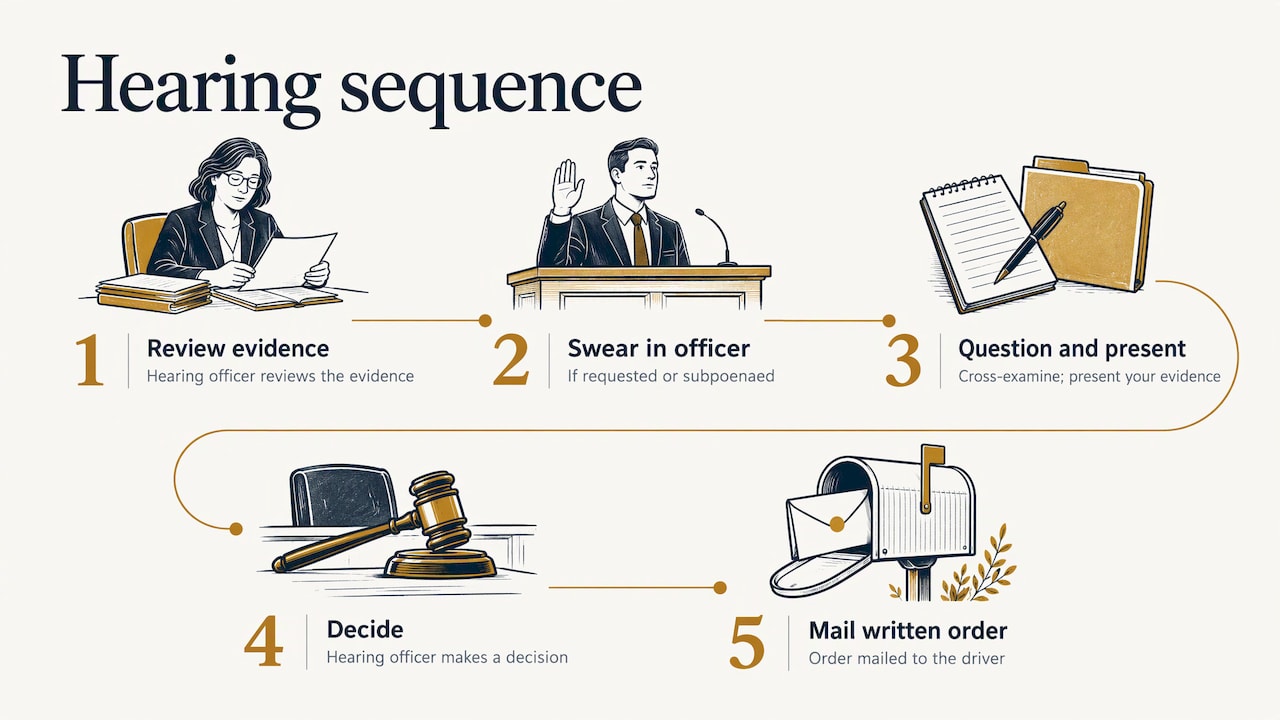
What Happens at a Colorado DUI DMV Hearing?
A DMV hearing resembles a simplified trial.
There is a hearing officer, evidence, witnesses, and an opportunity to challenge the government’s case.
But it’s an administrative proceeding, and the rules and standards differ from those in criminal court.
Most Colorado driver’s license hearings are currently conducted through Zoom.
Here’s how the process generally works.
1. The DMV Provides an Evidence Packet
The DMV ordinarily provides an Express Consent packet containing the documents submitted by law enforcement.
Depending on the case, it may include the officer’s affidavit, police reports, chemical test results, and related documents.
A mistake in the paperwork, an inconsistency between the officer’s reports and video evidence, or a problem with chemical testing can become an important issue.
2. The Hearing Is Scheduled
Under C.R.S. § 42-2-126(8), the DMV generally must schedule the hearing within 60 days after receiving the request.
There are limited statutory exceptions when the officer or hearing officer is unavailable.
If you request the hearing on time and qualify for a temporary driving permit, you may be allowed to continue driving while awaiting the hearing.
However, a temporary permit is not automatic in every situation.
You should confirm that your permit is valid before driving.
3. The Arresting Officer May Testify
If the officer’s attendance was properly requested or required, the officer may testify under oath.
Your attorney can cross-examine the officer.
I consider this an important part of many DMV hearings.
The officer may be questioned about the circumstances of the stop, the investigation, the basis for the arrest, the Express Consent advisement, and testing procedures.
Statements made under oath can sometimes reveal inconsistencies or weaknesses that become relevant in the criminal DUI case.
4. The Defense Can Present Evidence
The defense has an opportunity to present evidence and testimony.
Depending on the case, that could include recordings, documents, witness testimony, or other evidence relevant to the revocation.
The hearing officer evaluates the evidence under the applicable administrative rules.
5. The Hearing Officer Issues a Decision
The hearing officer determines whether the legal grounds for revocation have been established.
If the revocation is not sustained, the proposed administrative revocation does not go forward.
If the revocation is sustained, your driving privileges are revoked, subject to any available appeal or reinstatement options.
The decision is issued in writing.
What Can You Challenge at a Colorado DMV Hearing?
This is where having an experienced DUI attorney can make a difference.
Many people assume the only question is whether their blood alcohol content was over .08.
That’s not correct. For example: Can they prove you were driving? Or otherwise in actual physical control of the vehicle? Was the stop legal? Was the test completed within 2 hours of the time if driving?
The issues depend on whether the DMV is pursuing an excess-BAC revocation or a refusal revocation. Colorado law also permits challenges to the legality of the officer’s initial contact and arrest.
Challenging an Excess BAC Revocation
In an excess-BAC case involving an adult noncommercial driver, the DMV generally must establish that the person drove a motor vehicle in Colorado and had a blood alcohol concentration of .08 or higher at the time of driving or within two hours afterward.
Possible issues include whether the person was driving, when the driving occurred, whether the test result meets the statutory threshold, and whether the evidence reliably establishes the alleged alcohol concentration.
The exact timing of driving and testing can matter.
Depending on the evidence, there may be questions about testing procedures, reliability, and the relationship between the result and the time of driving.
Challenging a Refusal Revocation
In a refusal case, the questions are different.
The DMV must establish the required grounds for invoking Colorado’s Express Consent law and that the driver refused, failed to complete, or failed to cooperate with the required testing.
Possible defenses may involve:
-
Whether the officer had probable cause to invoke Express Consent.
-
Whether the driver actually refused testing.
-
Whether the driver’s conduct legally constituted a refusal.
-
Whether testing was properly requested under the statute.
-
Whether medical circumstances affected the driver’s ability to complete testing.
Sometimes a person believes they cooperated with the officer, while the officer reports a refusal.
Those cases require a careful examination of what was requested, what was said, and what actually happened.
Can You Challenge an Illegal Traffic Stop?
Yes.
This is an important point that is sometimes overlooked.
Colorado law expressly permits a driver to challenge the legality of the officer’s initial contact and subsequent arrest in the administrative revocation proceeding.
Under C.R.S. § 42-1-228 and § 42-2-126(8)(h), a driver who establishes that the initial contact or arrest was not constitutionally and statutorily valid may avoid revocation.
For example, an officer ordinarily needs reasonable suspicion to conduct an investigative traffic stop.
An unlawful stop can provide grounds to challenge the administrative action.
This is one reason I review the traffic stop itself, rather than limiting the analysis to the chemical test result.
The officer’s observations during field sobriety testing may also be relevant to whether probable cause existed.
What Happens if You Need to Reschedule the DMV Hearing?
Be careful.
Requesting a continuance of your DMV hearing can have an immediate effect on your driving privileges.
Under C.R.S. § 42-2-126(6)(d), a delay caused or requested by the driver or defense attorney does not continue the stay of revocation during that period.
That means your ability to drive under the temporary permit may end while you wait for the rescheduled hearing.
Sometimes a continuance is necessary to obtain evidence or prepare a defense.
But I would never request one without first considering how it affects the client’s ability to drive.
What Happens if You Lose Your DMV Hearing?
If the hearing officer sustains the revocation, you have two major questions to consider.
First, whether there are grounds to appeal the decision.
Second, when and how you can reinstate your driving privileges.
Can You Appeal a DMV Hearing Decision?
Yes.
Under C.R.S. § 42-2-126(9), a driver generally has 35 days after the Department issues its final determination to petition the district court for judicial review.
This isn’t a new trial.
The district court reviews the administrative record to determine whether the hearing officer committed a legal error, exceeded statutory authority, acted arbitrarily, or made a decision unsupported by the evidence.
The court generally does not hear new testimony.
Filing the appeal also does not automatically stop the license revocation.
A stay requires a separate motion and the necessary findings by the court.
How Long Will the DMV Revoke Your License After a DUI?
The length of the revocation depends on your age, the basis for the revocation, and your prior history.
For excess BAC and refusal cases, Colorado’s administrative revocation periods generally are:
| Violation | First | Second | Third or subsequent |
|---|---|---|---|
| BAC .08 or higher | 9 months | 1 year | 2 years |
| Chemical test refusal | 1 year | 2 years | 3 years |
| Underage excess BAC, greater than .02 but less than .08 | 3 months | 6 months | 1 year |
NOTE: You may be eligible for early reinstatement with an Interlock device and other conditions. Interlock length requirements will vary.
These periods are established by C.R.S. § 42-2-126.
Different provisions apply to commercial drivers and certain other situations.
For an underage driver whose first qualifying test result is .05 or below, a probationary license may be available after at least 30 days under the statutory conditions.
What About Revocation After a Criminal Conviction?
Your criminal case can create separate license consequences.
Under C.R.S. § 42-2-125, a first DUI or DUI per se conviction generally carries a nine-month revocation for an adult driver.
Multiple convictions can result in longer revocations.
A first DWAI conviction for an adult does not trigger the same nine-month conviction-based revocation as a DUI conviction, although DWAI carries substantial driver’s license points and other consequences.
When a DMV revocation and a conviction-based revocation arise from the same incident, the law generally provides for concurrent periods rather than simply adding the two revocations together.
But separate incidents, prior revocations, and additional driving restraints can substantially change the analysis.
That’s why I look at a client’s entire driving history, not just the current arrest.
What Is a Persistent Drunk Driver in Colorado?
Colorado uses the term Persistent Drunk Driver, commonly abbreviated PDD, for certain drivers who meet statutory criteria.
Despite the name, you don’t necessarily need multiple DUI convictions to receive this designation.
A person may qualify based on circumstances such as:
-
A BAC of .15 or higher.
-
Multiple qualifying alcohol-related driving violations.
-
Refusing a required chemical test.
-
Driving while under an alcohol-related license restraint.
A PDD designation generally brings additional reinstatement requirements.
These include Level II alcohol education and treatment, an ignition interlock restriction for at least two years, and applicable proof-of-insurance requirements.
A first-time offender can therefore face two years of ignition interlock requirements even without a prior DUI conviction.
For more information, see my article on Colorado ignition interlock requirements after a DUI.
Can You Get Your License Back Early After a DUI?
In many cases, yes.
Colorado permits some drivers to reinstate their licenses before completing the entire revocation period by participating in the ignition interlock program.
However, the requirements depend on the particular revocation.
For qualifying violations occurring on or after January 1, 2023, the rules generally include the following.
First DUI Per Se Revocation, BAC Below .15
A qualifying Colorado resident who was at least 21 at the time of the violation may be eligible to reinstate on the first day the revocation becomes active.
Under the rules in effect in 2026, the DMV generally requires a nine-month interlock restriction for qualifying first-time per se or DUI conviction cases involving a lower BAC.
The interlock period and revocation period can run concurrently.
First DUI Per Se Revocation, BAC .15 or Higher
Early reinstatement may also be available beginning on the first day of the active revocation.
However, a BAC of .15 or higher generally triggers the Persistent Drunk Driver requirements, including a two-year ignition interlock restriction.
Refusal of Chemical Testing
Under the law in effect in November 2026, a driver whose license was revoked for refusal generally must serve at least two months of the revocation before qualifying for early reinstatement with an ignition interlock device.
The interlock requirement is generally two years.
Second or Subsequent Alcohol-Related Revocations
Drivers with multiple alcohol-related violations may also qualify for early reinstatement.
However, the DMV generally imposes a two-year ignition interlock requirement, along with additional reinstatement conditions.
Prior offenses and other existing restraints can affect eligibility.
Drivers who were under 21 at the time of the violation and out-of-state residents generally do not qualify for the same Colorado early interlock reinstatement program.
What Do You Need to Reinstate Your License?
Depending on the circumstances, reinstatement may require:
-
An application for reinstatement.
-
A $95 reinstatement fee and applicable $25 DUI restoration fee.
-
Proof of SR-22 insurance.
-
Enrollment in or completion of required alcohol education and treatment.
-
Installation of an approved ignition interlock device.
-
Required affidavits, installation records, and other DMV documentation.
Your exact requirements depend on the reason for revocation and your driving history.
The easiest place to begin is the Colorado DMV Reinstatement Center.
You can check your reinstatement eligibility and required documents through myDMV.
Do not assume that your license automatically becomes valid when the revocation period ends.
You must complete the applicable reinstatement process and obtain the necessary driving authorization.
Driving while your license remains revoked can create additional criminal charges and licensing consequences.
Colorado’s DUI Interlock Laws Are Changing in 2027
Colorado enacted House Bill 26-1242 in 2026.
The principal changes take effect June 1, 2027.
Under the new law, certain first-time DUI and DUI per se offenders will generally be required to maintain an interlock-restricted driver’s license for nine consecutive months following reinstatement before becoming eligible for an unrestricted license.
Exceptions include qualifying early removal.
The legislation also eliminates the current two-month waiting period for early interlock reinstatement following certain chemical test refusals.
These changes are important, but they are not yet in effect as of November 2026.
For the complete legislation, see HB 26-1242 on the Colorado General Assembly’s website.
Why I Recommend Hiring an Attorney for Your DMV Hearing
When someone hires me for a DUI case, I don’t treat the DMV hearing as an unrelated administrative matter.
It’s part of the defense.
I’ve handled DUI cases as both a prosecutor and criminal defense attorney. I understand the evidence law enforcement relies on and how to examine it for weaknesses.
The DMV hearing can provide an early opportunity to challenge the stop, arrest, and chemical testing evidence.
It can also provide an opportunity to question an officer under oath before the criminal case reaches trial.
Sometimes the DMV hearing reveals problems with the state’s case. Other times, the testimony helps identify issues that require further investigation.
Even if the DMV hearing is unsuccessful, the evidence and testimony may help prepare the criminal defense.
Of course, winning the DMV hearing doesn’t automatically mean you’ll win the criminal case.
But I believe both proceedings deserve careful preparation.
You can learn more about how I defend these cases on my Colorado Springs DUI defense page, or review my Colorado DUI frequently asked questions.
Arrested for DUI in Colorado Springs? Don’t Miss Your DMV Deadline.
If you’ve been arrested for DUI or DWAI in Colorado Springs or El Paso County, the first thing you need to do is determine whether you have a DMV hearing deadline.
If you received an Express Consent Affidavit and Notice of Revocation, don’t put it aside.
You may have only seven calendar days to request a hearing.
At McDowell Law Firm, I personally handle criminal defense cases, including DUI and DWAI. I limit my caseload so I can give each case the attention it requires.
I can review the circumstances of your arrest, identify potential challenges to the DMV revocation, and help you understand what to expect in criminal court.
If you’re facing a DUI charge in Colorado Springs, contact McDowell Law Firm to discuss your case.

If your 7-day window is open, call as soon as you can. Learn more about our DUI defense practice and how we approach DUI, repeat DUI, and felony DUI cases.
Frequently Asked Questions About Colorado DMV DUI Hearings
Do I Have Seven Days From My DUI Arrest to Request a DMV Hearing?
If you received a Notice of Revocation from the officer after a breath test or refusal, you generally have seven calendar days from receipt of that notice. If you took a blood test, the deadline typically begins after the DMV mails its notice following the test results.
Can I Drive While Waiting for My DMV Hearing?
Possibly. If you requested the hearing on time and meet the statutory requirements for a temporary permit, you may be authorized to drive until the hearing. Verify the permit and its expiration date before driving.
What Happens if I Don’t Request a DMV Hearing?
You generally waive the right to a hearing, and the DMV revocation becomes final. Limited exceptions may apply when the person lacked actual notice or was physically unable to submit a timely request.
Can I Win My DMV Hearing if My BAC Was Above .08?
Potentially. A test result above .08 does not eliminate every available defense. Depending on the facts, you may be able to challenge the legality of the stop or arrest, the timing or reliability of the test, or other statutory elements.
Can an Illegal Traffic Stop Get My DMV Revocation Dismissed?
Yes. Under C.R.S. § 42-1-228 and § 42-2-126(8)(h), the legality of the initial contact and arrest can be challenged in a DMV hearing. If the evidence fails to establish the required legal validity, revocation may be avoided.
Should I Have the Arresting Officer Appear at My DMV Hearing?
That depends on the case. Officer testimony can provide an opportunity for cross-examination and may help prepare the criminal defense. But the decision should be made after considering the evidence and hearing strategy.
Can I Appeal if I Lose My DMV Hearing?
Yes. You generally have 35 days after the DMV’s final determination to petition the district court for judicial review. Filing an appeal does not automatically stay the revocation.
How Long Is My License Revoked for Refusing a Breath or Blood Test?
A first refusal generally results in a one-year revocation, a second refusal in a two-year revocation, and a third or subsequent refusal in a three-year revocation. Early reinstatement may be available with an ignition interlock device if you qualify.
Does a Dismissed DUI Charge Restore My License?
No. The criminal case and DMV case are separate. Dismissal of the DUI charge does not automatically invalidate a DMV revocation. You can “win” one side of the case, but lose the other (DMV and court) and lose your license.
What If I Live Outside Colorado but Was Arrested Here?
Colorado may revoke your privilege to drive in this state even if another state issued your license. Because of the interstate compact on licenses, your home state will likely honor the Colorado revocation and require you to meet conditions before you can legally drive again. You still need to address the Colorado DMV deadline. Your home state may impose additional consequences.
Colorado DMV Hearing Laws and Resources
-
C.R.S. § 42-2-125, Mandatory Revocation Following Conviction
-
C.R.S. § 42-1-228, Challenges to Initial Contact and Arrest
-
C.R.S. § 42-4-1301.1, Express Consent
Sources
-
Alcohol and Drug Related Offenses, Colorado Department of Revenue
-
Express Consent Cases Procedures, Colorado Department of Revenue