If your Colorado driver’s license has been revoked because of an alcohol-related driving case, an ignition interlock device may be part of getting back on the road.
An ignition interlock is a breath-testing device connected to your vehicle. You provide a breath sample before the car starts, and the device requires additional samples while you are driving.
The rules are more complicated than simply installing the device. Colorado regulates how long you must keep it, how often it must be serviced, what happens when alcohol is detected, and what can happen if the DMV believes you tampered with or tried to get around the device.
I am Josh McDowell, a Colorado Springs DUI defense attorney and former prosecutor. I deal with both the criminal and driver’s-license sides of DUI cases. One thing I regularly tell clients is that the DMV case and the criminal case are separate. What happens in court does not necessarily determine what happens to your driver’s license.
This article explains Colorado’s ignition interlock rules as they exist in 2026.
The law changes, and individual cases can be different. If you have received a notice from the Colorado DMV, look at the dates and requirements on your actual notice rather than relying only on general information online.
Explore DUI defense
Key Points About Colorado Ignition Interlock Devices
According to the Colorado DMV’s Ignition Interlock Program:
-
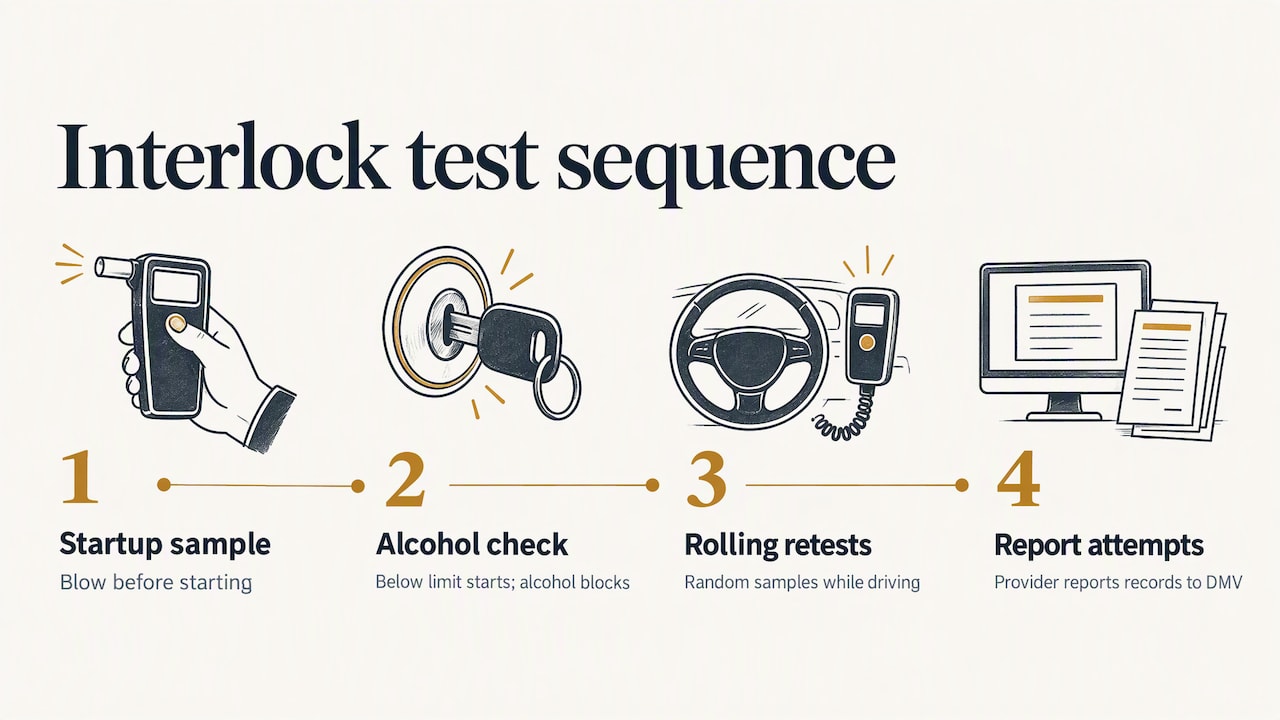
An ignition interlock requires a breath sample before the vehicle will start.
-
It also requires periodic breath samples while the vehicle is being driven.
-
An interlock-restricted driver generally must drive a vehicle equipped with an approved interlock device.
-
The device must be serviced at least once every 60 days.
-
Driving a vehicle without the required device or attempting to circumvent the device can lead to serious additional license consequences.
Colorado treats a breath alcohol reading of .025 or higher as an excessive breath alcohol event for interlock purposes.
That is much lower than the .08 BAC level associated with DUI per se. The two standards serve different purposes.
What Does an Ignition Interlock Device Do?
An ignition interlock is installed in your vehicle and connected to its ignition system.
Before starting the vehicle, you blow into the device. If the device detects alcohol above its programmed threshold, it may prevent the vehicle from starting.
The device also requires periodic breath tests while the vehicle is operating. The Colorado DMV refers to these as periodic breath samples.
The device records information that is reported through the approved interlock provider.
That information matters because the DMV can use interlock reports when deciding whether you complied with the terms of your interlock-restricted license.
Ignition interlock test and reporting sequence
Ignition Interlock vs. a Regular Breathalyzer
A personal breathalyzer and an ignition interlock are not interchangeable.
A handheld breath-testing device gives an alcohol reading. An ignition interlock is installed in a vehicle and controls whether the vehicle can be started.
For purposes of a Colorado interlock-restricted license, you must use an approved ignition interlock device installed by an approved provider. Carrying your own breathalyzer does not satisfy the requirement.
Who Has to Use an Ignition Interlock in Colorado?
There is no single answer that applies to every DUI case.
Colorado’s interlock requirements depend on why your license was revoked, your driving history, your BAC, whether you are classified as a persistent drunk driver, and whether you are seeking early reinstatement.
Under current Colorado law, interlock requirements can apply to several categories of drivers.
For example, Colorado law generally requires an interlock-restricted license for certain persistent drunk drivers, drivers whose licenses were revoked based on multiple alcohol-driving convictions, certain habitual traffic offenders, and drivers whose licenses were revoked for interlock circumvention.
An interlock can also be required when someone receives early reinstatement before completing the full period of an alcohol-related license revocation.
This is why you should determine the exact basis for your revocation before assuming how long you will need an interlock.
For more information about the driver’s-license side of a DUI case, see:
Interlock vs. a regular breathalyzer
People often ask about a breathalyzer vs. an interlock device. They both measure alcohol on your breath, but they do different jobs.
| Handheld breathalyzer | Ignition interlock | |
|---|---|---|
| Who uses it | Officers at a stop, or private individuals | Drivers with an interlock-restricted license |
| What it does | Gives a reading | Gives a reading and controls whether the vehicle starts |
| Connected to the vehicle | No | Yes, wired to the ignition |
| Reports to the state | No | Yes, through an approved provider |
| Can you substitute one for the other | No | A personal breathalyzer does not satisfy a legal interlock requirement |
A Major Change Is Coming in 2027
Colorado passed House Bill 26-1242 in 2026, but an important part of the new law does not take effect until June 1, 2027.
Beginning on that date, certain first-time DUI and DUI per se offenders will generally have to maintain an interlock-restricted license for nine consecutive months after reinstatement before receiving an unrestricted license, unless they qualify for early removal.
The law also changes early reinstatement rules for some drivers whose licenses were revoked for refusing chemical testing.
You can read the Colorado General Assembly’s summary of HB 26-1242 here.
The important point for someone dealing with a DUI now is the effective date.
The new nine-month requirement is not the current rule in October 2026. It becomes effective June 1, 2027.
What If the DUI Happened in Another State?
An out-of-state DUI can create additional problems because you may have to deal with both the state where the arrest occurred and Colorado’s licensing system.
The criminal case is normally handled in the state where the alleged offense happened. Your Colorado driving privilege is controlled by Colorado.
If you are a Colorado driver arrested elsewhere, do not assume that resolving the criminal case resolves your Colorado license.
For an example of how another state handles the release process after an arrest, see this information on DUI bail bonds in California.
How Do I Get an Ignition Interlock Installed?
Colorado requires drivers to use an approved ignition interlock provider.
The DMV maintains a current list of approved ignition interlock vendors.
The general process looks like this:
-
Determine whether you are eligible for reinstatement.
-
Determine how long the interlock restriction will apply.
-
Choose an approved interlock provider.
-
Have the device installed.
-
Complete the DMV’s reinstatement requirements.
-
Follow the servicing and monitoring requirements throughout the restriction period.
Colorado also uses the Restricted License Ignition Interlock Agreement Affidavit, Form DR 2058, as part of the interlock process.
Your provider should explain how to provide a proper breath sample, what the device’s warnings mean, and how periodic tests work.
How Often Must an Interlock Be Serviced?
This is important.
Colorado requires the device to be serviced at least once every 60 days.
According to the Colorado DMV, failing to report for required servicing can result in suspension of your driving privilege until you come back into compliance.
If your interlock lease is canceled before you have completed the required interlock period, that can also result in a suspension until you enter into another qualifying lease.
Put your service dates on your calendar and keep records showing that you attended.
How Much Does an Ignition Interlock Cost in Colorado?
Colorado drivers generally lease ignition interlock devices rather than buying them.
Costs can include:
-
Installation
-
Monthly lease charges
-
Periodic service or calibration
-
Removal
-
Other provider charges
Prices vary among providers and can also depend on the vehicle.
Before choosing a company, call several providers from the state’s approved list and ask for a complete written fee schedule.
There are other expenses associated with a DUI case that are separate from the interlock itself. These can include reinstatement fees, alcohol education or treatment, insurance costs, court costs, fines, and other conditions.
Our Colorado DUI penalties guide discusses many of those consequences.
Can Colorado Help Pay for an Ignition Interlock?
Possibly.
Colorado operates an Ignition Interlock Financial Assistance Program.
Under the current program, eligible drivers may receive financial assistance toward interlock costs. Total assistance available through the current program cannot exceed $400.
Eligibility can include certain first-time offenders and certain persistent drunk drivers completing their initial interlock installation. Income requirements also apply.
The provider checks eligibility through the state’s system during installation.
If the system determines that you are not eligible but you believe the income information is incorrect or outdated, there is an appeal process.
The DMV specifically states that an appeal based on tax information requires an IRS tax transcript. A copy of your tax return is not enough.
HB 26-1242 will also change portions of the financial-assistance program beginning in 2027, so check the current DMV requirements when you install the device.
What Counts as an Interlock Violation?
This is one of the most confusing parts of Colorado’s interlock law.
Drivers often see words like “fail,” “lockout,” or “violation” on a provider report and assume that the DMV treats every one of those events the same way.
It does not.
Colorado’s legal rules focus on specific types of events.
Two of the most important are excessive breath alcohol events and circumvention or tampering.
Excessive Breath Alcohol Events
For Colorado interlock purposes, excessive breath alcohol content is a reading of .025 or higher.
But one .025 reading does not automatically mean your interlock period will be extended.
According to the Colorado Department of Revenue’s Hearings Division, an extension may occur when the provider reports excessive breath alcohol events in three separate months within twelve consecutive months.
If the DMV finds the required pattern, it can extend the interlock requirement for up to one additional year.
If you do not challenge the extension or agree to extend the lease, the default extension is one year.
This distinction matters.
Your interlock company’s use of the term “lockout” is not necessarily the same thing as a legally sufficient event for a DMV extension.
Can Mouthwash or Food Cause an Interlock Reading?
Ignition interlock devices detect alcohol in the breath sample. They do not determine why alcohol is present.
Products containing alcohol can potentially create readings. That can include some mouthwashes and other products.
If you receive a reading that you believe does not reflect drinking alcohol, document what happened and follow the instructions provided by your interlock company.
Do not attempt to defeat the device, disconnect it, or have someone else provide a breath sample for you.
Tampering or Circumvention
Tampering and circumvention are much more serious than an isolated alcohol reading.
Colorado prohibits an interlock-restricted driver from circumventing the device.
Examples can include driving a vehicle that is not equipped with the required interlock or having someone else provide a breath sample in an attempt to defeat the device.
According to the Colorado DMV, an interlock-restricted driver who drives a non-equipped vehicle or attempts to circumvent the proper functioning of the device is subject to a license revocation with no driving for at least one year.
Circumvention cases can involve either a criminal conviction or an administrative DMV proceeding, depending on the circumstances.
If the DMV accuses you of circumvention or tampering, treat the notice seriously.
What About Missed Breath Tests?
The device requires periodic breath samples while you are driving.
Do not ignore a request for a breath sample.
At the same time, a provider notation on a report does not automatically tell you what legal consequence the DMV will impose.
If the DMV sends you a notice based on your interlock reports, the important question is what statutory or regulatory violation the DMV alleges and what evidence supports it.
Can I Contest an Interlock Extension or Revocation?
Yes, depending on the type of action.
If the DMV sends a notice extending your interlock restriction based on excessive breath alcohol events, you can request a hearing.
At the hearing, the hearing officer can review the monitoring reports and determine whether the alleged events qualify under Colorado law.
The Colorado Department of Revenue explains that the hearing officer can also consider aggravating and mitigating circumstances when deciding the length of an extension.
Colorado’s administrative rules for these cases are contained in Rule 11, Interlock-Restricted Licenses.
When I review one of these cases, I want to know:
-
What exactly does the provider report show?
-
Are there qualifying excessive breath alcohol events?
-
Did qualifying events occur in three separate months within twelve consecutive months?
-
Is the DMV alleging alcohol events, circumvention, tampering, or something else?
-
Is there an innocent explanation supported by records or other evidence?
-
What is the deadline to request a hearing?
Do not ignore a DMV notice. Administrative deadlines can be short.
Can You Get an Ignition Interlock Removed Early?
Some drivers can.
Under the current rules, the Colorado Department of Revenue states that early removal is potentially available to drivers who begin with an eight-month interlock requirement.
Generally, the driver must have:
-
Reinstated early following a first-time alcohol offense.
-
Had a chemical test result below .150.
-
Completed four months of successful interlock driving.
Successful driving requires four consecutive monthly reporting periods without the disqualifying events identified by Colorado law.
That includes no qualifying excessive breath alcohol event that prevents or interrupts normal operation of the vehicle, no detected tampering, no other reports of circumvention or tampering, and no other grounds for extending the restriction.
Do not remove the device just because you believe four months have passed.
The DMV states that qualifying drivers will receive notice that they are eligible for early removal. If you believe you qualify and have not received approval, you can contact the DMV or request a hearing.
Practical Tips While You Have an Interlock
A few simple habits can prevent unnecessary problems:
-
Keep every service appointment.
-
Keep copies of your installation, service, and calibration records.
-
Follow your provider’s instructions before providing a breath sample.
-
Never have another person blow into the device for you.
-
Never drive a vehicle that you are prohibited from driving under your interlock restriction.
-
If the device appears to malfunction, contact the provider immediately and document the problem.
-
Save your monthly monitoring reports if you receive them.
-
Do not remove the device until the DMV confirms that you are legally permitted to do so.
How a Colorado DUI Lawyer Can Help
The driver’s-license consequences of a DUI can become complicated quickly.
The criminal case and DMV case are separate. An interlock issue can create another layer after you have already dealt with a revocation or court case.
If you receive a DUI charge, a DMV revocation notice, an interlock-extension notice, or an allegation of circumvention, you should understand exactly what the government is alleging before you decide what to do.
I am a former prosecutor and have defended DUI cases in Colorado Springs for years. If you are facing a DUI or DWAI charge in Colorado Springs or El Paso County, you can start with our Colorado Springs DUI defense page.
We can review both the criminal case and the driver’s-license consequences and explain what options apply to your particular situation.
Frequently Asked Questions
What BAC causes an ignition interlock violation in Colorado?
Colorado treats .025 or greater as excessive breath alcohol content for purposes of its interlock rules.
However, one reading at or above .025 does not automatically result in a one-year extension.
The DMV generally looks for qualifying excessive breath alcohol events occurring in three separate months within twelve consecutive months before issuing an extension based on excessive BAC.
How often must a Colorado ignition interlock be serviced?
At least once every 60 days.
The Colorado DMV warns that failing to report for required servicing can result in suspension until you return to compliance.
Can I drive someone else’s car while I have an interlock license?
Colorado prohibits an interlock-restricted driver from operating a vehicle that is not equipped with the required approved ignition interlock device.
Driving a non-equipped vehicle can have serious licensing consequences.
Check the restrictions on your license and speak with the DMV or your attorney before driving another vehicle.
Does one failed interlock test extend my license restriction?
Not automatically.
For an extension based on excessive breath alcohol content, the DMV looks for qualifying events in three separate months within twelve consecutive months.
Tampering and circumvention are governed by different rules and can result in much more serious consequences.
Can Colorado help pay for my ignition interlock?
Possibly.
Colorado’s Ignition Interlock Financial Assistance Program currently provides up to $400 in assistance for qualifying drivers, subject to eligibility requirements and available funds.
How soon can I remove my interlock?
It depends on the type and length of your restriction.
Under the rules in effect in 2026, certain first-time offenders who begin with an eight-month interlock requirement may qualify for early removal after four consecutive months of successful interlock driving.
Do not remove the device until the DMV has authorized you to do so.
Is Colorado changing its ignition interlock laws?
Yes.
House Bill 26-1242 was signed into law in 2026. Its primary changes to first-offense interlock requirements take effect June 1, 2027.
Among other changes, certain first-time DUI and DUI per se offenders will generally be required to maintain an interlock-restricted license for nine consecutive months following reinstatement, subject to early-removal provisions. Additionally, the 2027 law will repeal the 2-month waiting period for early interlock reinstatement for refusals.
Official Sources
-
Restricted License Ignition Interlock Agreement Affidavit, DR 2058
-
Transportation and Motor Vehicles: Summary of Major Legislation 2026