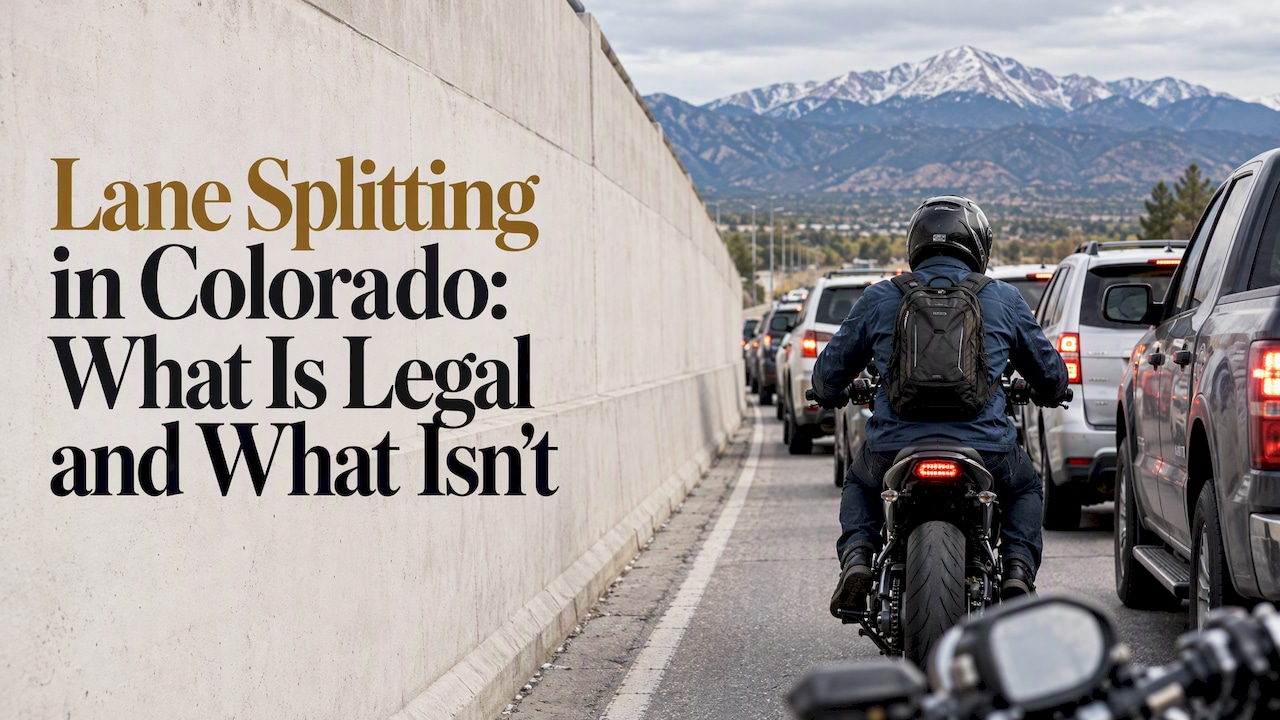
Lane splitting and lane filtering are not the same thing under Colorado law.
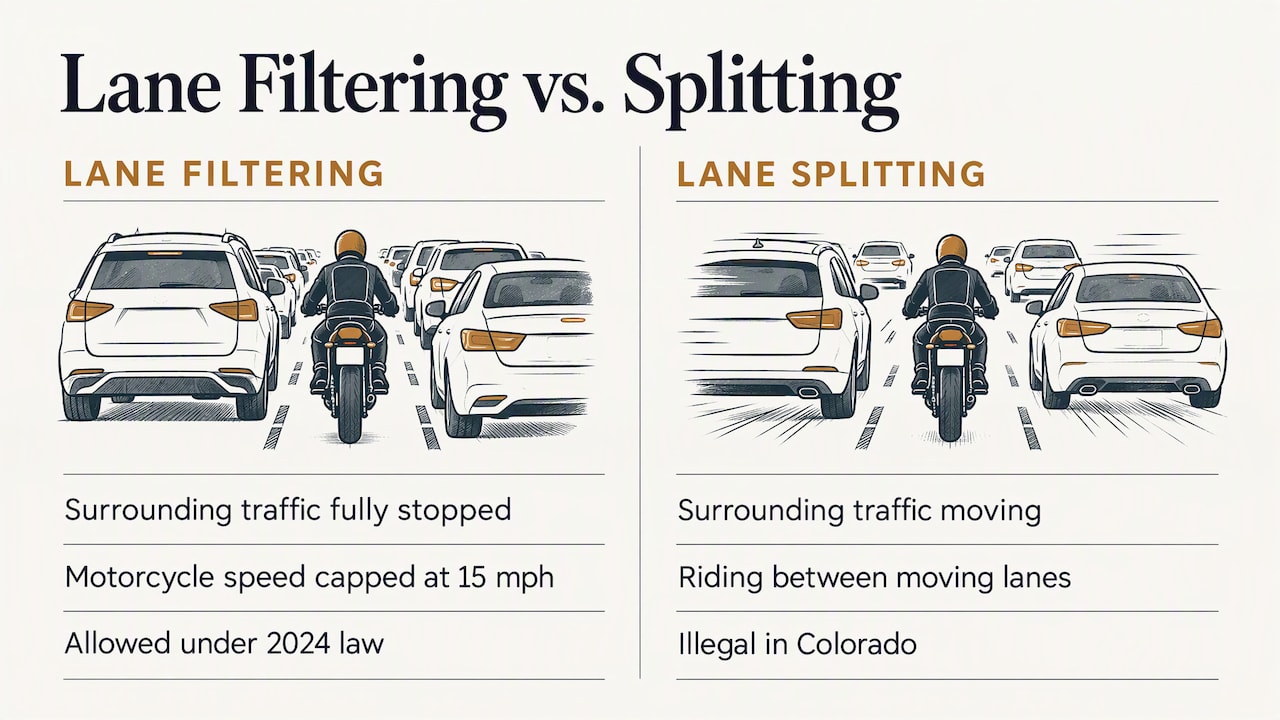
Lane splitting, riding between lanes while surrounding traffic is moving, remains illegal in Colorado.
Lane filtering became legal for certain two-wheeled motorcycles on August 7, 2024. But the exception is narrow. The surrounding traffic must be completely stopped, the motorcycle cannot exceed 15 mph, and several other conditions must be met.
The law is also temporary. Colorado’s lane-filtering authorization is scheduled to end on September 1, 2027, unless the General Assembly extends it.
If you ride a motorcycle in Colorado, the distinction matters. A maneuver that begins as legal filtering can become illegal lane splitting as soon as traffic starts moving.
Table of Contents
-
Lane splitting vs. lane filtering: the difference in plain terms
-
Who is at fault if a motorcycle is filtering or splitting during a crash?
Key Takeaways
-
Lane splitting through moving traffic remains illegal in Colorado.
-
Lane filtering is legal only when the statutory requirements are satisfied.
-
The vehicles being passed and traffic in adjacent lanes traveling in the same direction must be completely stopped.
-
The motorcycle cannot travel faster than 15 mph while filtering.
-
Lane filtering applies only to two-wheeled motorcycles.
-
If traffic begins moving, the rider must stop the passing maneuver.
-
Legal lane filtering does not automatically give the motorcycle the right of way or determine fault after a crash.
-
The lane-filtering authorization is currently scheduled to end September 1, 2027.
Lane Splitting vs. Lane Filtering in Colorado
People often use the terms lane splitting and lane filtering interchangeably. Colorado law treats them very differently.
Lane splitting generally means riding a motorcycle between lanes or rows of vehicles while traffic is moving. The Colorado State Patrol describes lane splitting as illegal.
Lane filtering is much narrower. It allows the driver of a qualifying two-wheeled motorcycle to move past stopped vehicles under specific conditions.
The Colorado Department of Transportation describes filtering as allowing motorcycles to slowly pass stopped vehicles traveling in the same direction.
The critical difference is whether traffic is stopped.
It does not matter that traffic is moving only two or three miles per hour. The Colorado filtering exception applies to stopped traffic, not merely slow traffic.
The 15 mph number is also frequently misunderstood. It is the maximum speed of the motorcycle while legally filtering. It does not mean that a rider may travel between vehicles moving at less than 15 mph.
If the cars are moving, the lane-filtering exception generally does not apply.
What Colorado’s Lane Filtering Law Requires
Colorado legalized limited motorcycle lane filtering through Senate Bill 24-079.
The law allows the driver of a two-wheeled motorcycle to pass another motor vehicle in the same lane only when the statutory conditions are satisfied.
According to the statute and the CDOT lane-filtering guidance, the important requirements include:
-
The vehicle being passed must be completely stopped.
-
Traffic in adjacent lanes traveling in the same direction must also be stopped.
-
The lanes must be wide enough for the motorcycle to pass safely.
-
Conditions must permit the motorcycle to be operated prudently while passing.
-
The motorcycle may not exceed 15 mph while filtering.
-
The rider may not use the right shoulder to pass.
-
The rider may not enter a lane of traffic traveling in the opposite direction.
The statute also places restrictions on passing to the right of vehicles in the farthest right-hand lane on certain roads.
The important point is that lane filtering is a narrow exception to Colorado’s normal prohibition against riding between vehicles. It is not a general permission to ride between lanes whenever traffic is congested.
What Happens When Traffic Starts Moving?
This is one of the most important parts of the law.
Traffic may be completely stopped when a rider begins filtering. Then the light changes or the congestion begins moving.
Colorado law requires the rider to stop the passing maneuver when the vehicles being overtaken begin moving.
You cannot continue traveling between the lanes simply because the maneuver began legally.
This is also where legal filtering can quickly turn into illegal lane splitting.
The Colorado State Patrol has specifically warned riders about the difference between completely stopped traffic and traffic that is slowly moving. Its guidance on Colorado’s lane-filtering law stresses that filtering does not authorize motorcycles to continue passing once traffic starts rolling.
If surrounding traffic is creeping forward, even very slowly, the statutory filtering exception does not apply.
Which Motorcycles Can Lane Filter?
The law applies only to two-wheeled motorcycles.
The Colorado Department of Transportation specifically explains that e-bikes and electric scooters do not qualify.
Three-wheeled motorcycles also fall outside the lane-filtering authorization.
That distinction can be confusing because Colorado motorcycle endorsements may cover both two-wheeled and three-wheeled motorcycles. The filtering law is narrower than the licensing rules.
If you are operating a motorcycle with three wheels or another vehicle that does not qualify as a two-wheeled motorcycle, you should not assume the lane-filtering exception applies.
Can You Lane Filter on the Shoulder?
No.
Colorado’s filtering law does not give motorcycle riders permission to use the shoulder to bypass stopped traffic.
The law specifically prohibits passing on the right shoulder.
That means a rider cannot simply move onto the shoulder during congestion and characterize the maneuver as lane filtering.
Legal filtering occurs within the roadway under the conditions established by the statute.
Colorado’s Lane Filtering Law Is Temporary
Colorado’s lane-filtering law is currently an experiment rather than a permanent authorization.
The law is scheduled to be repealed on September 1, 2027.
The state is collecting safety information and evaluating the effects of lane filtering. According to CDOT, a report is due before the current authorization expires.
As of October 19, 2026, qualifying lane filtering remains legal.
Unless the General Assembly changes the law, however, the authorization will end September 1, 2027.
Because the law may change, riders should confirm the current status before relying on it.
The CDOT motorcycle lane-filtering page is a good place to check.
Is Lane Splitting Still Illegal in Colorado?
Yes.
Colorado’s new law did not generally legalize riding between lanes.
It created a limited exception allowing certain motorcycles to pass stopped traffic under specified conditions.
Riding between vehicles that are moving remains outside that exception.
The Colorado State Patrol continues to distinguish illegal lane splitting from lawful lane filtering based largely on whether surrounding traffic is moving or stopped.
A rider who travels between moving vehicles could face a traffic citation depending on what occurred.
More serious conduct can potentially result in charges such as careless driving or reckless driving.
Colorado generally classifies reckless driving as a class 2 misdemeanor traffic offense. Ordinary careless driving when no bodily injury or death results is also a class 2 misdemeanor traffic offense, although the consequences change when careless driving results in injury or death.
You can read more about those offenses in our guide to careless driving vs. reckless driving.
Traffic convictions can also carry driver’s-license points. Our guide to Colorado traffic fines and points explains how the point system works.
Who Is at Fault in a Lane-Filtering Motorcycle Crash?
The fact that a motorcycle was filtering does not automatically answer the fault question.
Legal lane filtering does not give the motorcycle an unlimited right of way. But the fact that a rider was filtering also does not automatically make that rider responsible for a collision.
Fault depends on what each person did.
Examples include:
-
A motorcycle rider exceeds 15 mph while filtering.
-
The rider continues between vehicles after traffic starts moving.
-
The available space is too narrow to pass safely.
-
A driver suddenly changes lanes while the motorcycle is lawfully filtering.
-
A driver opens a door into the motorcycle’s path.
-
A rider enters an opposing lane while attempting to pass.
-
A rider is lane splitting through moving traffic rather than lawfully filtering.
Each situation presents different evidence.
The Colorado State Patrol’s lane-filtering guidance emphasizes that riders remain responsible for determining whether conditions allow the maneuver to be performed safely.
That does not create an automatic legal presumption that the motorcycle rider caused every filtering accident.
Insurance companies, attorneys, and ultimately a jury may need to evaluate the actions of both drivers.
Colorado Comparative Negligence and Motorcycle Accidents
Colorado allows fault to be divided between people involved in an accident.
That means a motorcycle rider can be partly responsible for a crash without necessarily losing the entire injury claim.
Colorado follows a modified comparative negligence system. If the injured rider is partly negligent, any damages awarded can generally be reduced according to the rider’s percentage of fault.
However, if the injured person is found equally or more negligent than the person from whom recovery is sought, recovery against that person can be barred.
For example, assume a jury determines that a motorcycle rider suffered $100,000 in damages but was 20 percent responsible for the accident.
The recoverable damages could potentially be reduced to $80,000.
That is one reason the precise facts of a filtering accident matter.
Whether traffic was completely stopped, how fast the motorcycle was traveling, where the vehicles were positioned, and whether another driver attempted a sudden lane change can all become important.
Evidence to Preserve After a Lane-Filtering Accident
If you are involved in a motorcycle crash, evidence can disappear quickly.
If you can safely do so, consider preserving:
-
Photographs of the roadway and lane widths.
-
Photographs showing the final positions of the motorcycle and vehicles.
-
Damage to the motorcycle and other vehicles.
-
Skid marks, debris, and scrape marks.
-
Helmet-camera footage.
-
Dashcam footage.
-
Contact information for witnesses.
-
Nearby business or traffic-camera footage.
Medical documentation also matters.
Some motorcycle injuries are obvious immediately. Others may become more apparent after the adrenaline from the crash wears off.
Avoid guessing about your exact speed, distance, or other details when speaking with an insurance company if you do not actually know the answer.
Should You Lane Filter Just Because It Is Legal?
No.
The law gives qualifying riders the option to filter under limited circumstances. It does not require anyone to do it.
A lane may technically be wide enough to pass while still creating a difficult or risky situation.
Large trucks, mirrors, saddlebags, road construction, potholes, turning vehicles, driveways, and distracted drivers can all change the risk.
The Colorado State Patrol and CDOT encourage riders to use judgment.
The legal maximum is 15 mph. That does not mean 15 mph is always a safe filtering speed.
Conditions may require traveling substantially slower or remaining in the traffic lane entirely.
The Colorado Motorcycle Operator Handbook also provides guidance on lane positioning, visibility, and motorcycle safety.
Colorado Motorcycle License Requirements
Colorado requires motorcycle riders to have the appropriate license endorsement.
According to the Colorado DMV:
-
An M endorsement permits operation of two-wheeled and three-wheeled motorcycles.
-
A 3 endorsement is limited to three-wheeled motorcycles.
-
Riders can qualify through motorcycle testing or through an approved Motorcycle Operator Safety Training program.
-
Riders under 18 generally must hold a motorcycle instruction permit for 12 months before receiving the endorsement.
-
Riders under 16 must successfully complete an approved motorcycle safety training program before obtaining a motorcycle instruction permit.
-
Colorado does not issue a separate motorcycle-only driver’s license.
-
Motorcycle endorsements generally must be added through a driver-license office rather than online, by mail, or by phone.
Remember that having an endorsement that allows operation of a three-wheeled motorcycle does not mean that three-wheeled motorcycles qualify for lane filtering.
The filtering statute applies specifically to two-wheeled motorcycles.
If You Were Ticketed for Lane Splitting or Filtering
A traffic ticket is an accusation, not a conviction.
If you receive a citation related to lane splitting or lane filtering, look carefully at the specific offense listed on the ticket.
Useful steps may include:
-
Keep the ticket and note every court deadline.
-
Write down what happened while the details are still fresh.
-
Preserve helmet-camera, dashcam, or other video.
-
Photograph the road if lane width or roadway configuration matters.
-
Identify witnesses who saw whether traffic was moving or stopped.
-
Avoid making unnecessary statements about disputed facts.
-
Talk with a traffic attorney before automatically paying the citation.
Paying a traffic ticket can amount to accepting the charge and may result in points or other consequences.
Our article on how long a traffic ticket stays on your record explains some of the issues that can follow a traffic conviction.
In a filtering case, seemingly small facts may matter.
Was the traffic actually stopped?
Was an adjacent lane moving?
How fast was the motorcycle traveling?
Was the lane wide enough to pass safely?
Did traffic begin moving during the maneuver?
Video can sometimes answer those questions much more reliably than competing recollections.
How McDowell Law Firm Can Help
I’m Josh McDowell, a Colorado Springs trial attorney and former prosecutor. I limit my caseload so I can personally handle the cases I accept and communicate directly with my clients.
Motorcycle incidents can involve both criminal or traffic issues and personal injury claims.
If you received a citation for careless driving, reckless driving, or another traffic offense, our traffic defense practice can review the charge and the evidence.
If you were injured because of another driver’s actions, our personal injury practice represents people injured in motorcycle, car, and truck accidents, as well as wrongful death cases.
Personal injury cases are handled on a contingency fee of 33-40%, so there is no upfront retainer for the injury claim itself.
If the crash was relatively minor and you are unsure whether you need a lawyer, our article on whether to hire a lawyer after a minor car accident may help.
Frequently Asked Questions
Is lane splitting legal in Colorado?
No. Riding between lanes of moving traffic remains illegal in Colorado. Colorado legalized limited lane filtering, which permits qualifying two-wheeled motorcycles to pass stopped traffic under specific conditions.
Is lane filtering legal in Colorado?
Yes, as of October 2026. The current authorization allows qualifying two-wheeled motorcycles to filter through completely stopped traffic under the conditions established by Colorado law.
The authorization is currently scheduled to end September 1, 2027 unless lawmakers extend it.
How fast can you go while lane filtering in Colorado?
The motorcycle may not exceed 15 mph while filtering.
Fifteen mph is a maximum, not a recommended speed for every situation. The law also requires conditions to permit prudent operation.
Can traffic be moving while I lane filter?
No.
The vehicle being passed and adjacent traffic traveling in the same direction must be stopped.
If traffic begins moving during the maneuver, the rider must stop overtaking the vehicles.
Can I lane filter on the shoulder?
No.
Colorado’s filtering exception does not permit passing on the right shoulder.
Can I lane filter on an e-bike or electric scooter?
No.
The authorization applies to qualifying two-wheeled motorcycles. The CDOT lane-filtering guidance states that e-bikes and electric scooters do not qualify.
Can a three-wheeled motorcycle lane filter?
No.
The filtering authorization is limited to two-wheeled motorcycles.
Is the motorcycle rider automatically at fault after a lane-filtering accident?
No.
Fault depends on the circumstances of the crash and the conduct of everyone involved.
Whether the motorcycle rider complied with the filtering law will be important, but another driver’s negligence can also contribute to or cause a collision.
Can you get a ticket for illegal lane splitting?
Yes.
The specific citation depends on the facts. Depending on how the motorcycle was being operated, potential offenses may include careless driving, reckless driving, or another traffic violation.
Sources
Motorcycle Lane Filtering, Colorado Department of Transportation
Lane Filtering in Colorado, Colorado State Patrol
Colorado State Patrol Warns Riders to Respect the Colorado Lane Filtering Law
SB24-079 Motorcycle Lane Filtering & Passing, Colorado General Assembly
I’m a Motorcycle Driver, Colorado DMV
Colorado Motorcycle Operator Handbook, Colorado DMV
Crime classification guide: misdemeanor traffic offenses, Colorado General Assembly
This article is general information about Colorado law and is not legal advice for your specific situation.
Sources
-
Motorcycle Lane Filtering, Colorado Department of Transportation
-
Colorado State Patrol Warns Riders to Respect the Colorado Lane Filtering Law
-
SB24-079 Motorcycle Lane Filtering & Passing, Colorado General Assembly
-
Crime classification guide: misdemeanor traffic offenses, Colorado General Assembly
Recommended
-
Leaving the Scene of an Accident in Colorado: Penalties, Charges
-
When Does a Traffic Ticket Become a Criminal Charge in Colorado?
-
Careless Driving vs Reckless Driving: What’s the Difference?