
Most people know you cannot drive around Colorado drinking a beer. But Colorado’s open container laws are a little more complicated than that.
For one thing, the law applies to passengers as well as drivers. Second, an open container does not necessarily have to be sitting in a cup holder. And perhaps most interesting, Colorado has separate open container laws for alcohol and marijuana, and the definition of an “open container” is different for each.
There is also the question I hear frequently with almost every traffic ticket: how many points does it carry?
Here is how Colorado’s open container laws work.
Colorado’s alcohol open container law is found at C.R.S. § 42-4-1305.
The law generally prohibits a person from knowingly drinking alcohol or possessing an open alcoholic beverage container in the passenger area of a motor vehicle while the vehicle is on a public highway or the right-of-way of a public highway.
An “open alcoholic beverage container” is a bottle, can, or other container that contains any amount of alcohol and either:
The container is open or has a broken seal; or
Some of the contents have been removed.
That “or” matters.
A half-full bottle of whiskey does not become legal simply because someone screwed the cap back on. If some of the contents have already been removed, it can still qualify as an open container under the statute.
Where Can You Keep an Open Bottle?
The law focuses on the “passenger area” of the vehicle.
That includes the places designed for the driver and passengers as well as areas readily accessible to them while seated. The statute specifically includes the glove compartment.
The safest place for an opened bottle of alcohol is generally the trunk.
Colorado also creates exceptions for vehicles without trunks. An open container may be kept behind the last upright seat or in another area that is not normally occupied by the driver or passengers.
So if you take an unfinished bottle of wine home from dinner, putting it in the trunk is considerably better than putting it on the floor behind the driver’s seat.
Colorado’s alcohol open container law is found at C.R.S. § 42-4-1305.
The law generally prohibits a person from knowingly drinking alcohol or possessing an open alcoholic beverage container in the passenger area of a motor vehicle while the vehicle is on a public highway or the right-of-way of a public highway.
An “open alcoholic beverage container” is a bottle, can, or other container that contains any amount of alcohol and either:
The container is open or has a broken seal; or
Some of the contents have been removed.
That “or” matters.
A half-full bottle of whiskey does not become legal simply because someone screwed the cap back on. If some of the contents have already been removed, it can still qualify as an open container under the statute.
Where Can You Keep an Open Bottle?
The law focuses on the “passenger area” of the vehicle.
That includes the places designed for the driver and passengers as well as areas readily accessible to them while seated. The statute specifically includes the glove compartment.
The safest place for an opened bottle of alcohol is generally the trunk.
Colorado also creates exceptions for vehicles without trunks. An open container may be kept behind the last upright seat or in another area that is not normally occupied by the driver or passengers.
So if you take an unfinished bottle of wine home from dinner, putting it in the trunk is considerably better than putting it on the floor behind the driver’s seat.
What Colorado law says about open containers
Two statutes control. Section 42-4-1305 covers open alcoholic beverage containers, and C.R.S. §42-4-1305.5 covers open marijuana containers. The alcohol statute bars having or consuming an open container in the passenger area of a motor vehicle on a public highway. Colorado guidance also addresses open marijuana containers when there is evidence of consumption.
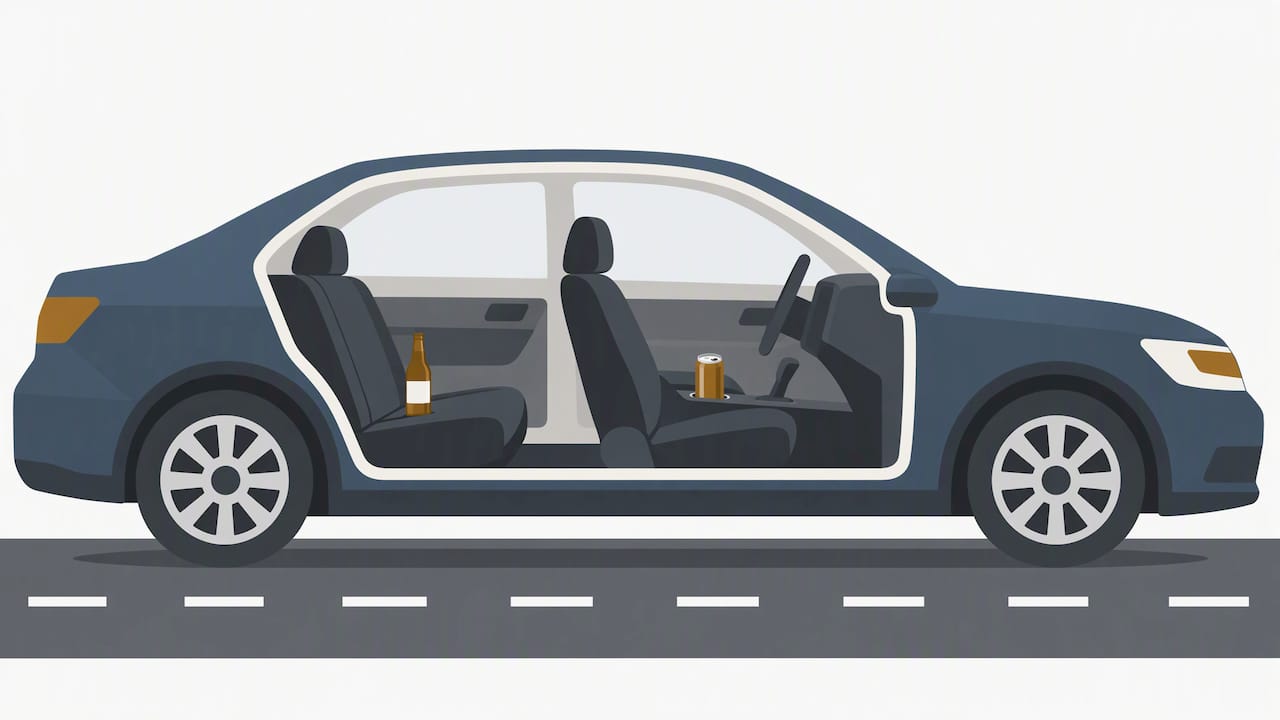
“Open” is broader than most people assume. The statute defines what counts as an open container and a passenger area. Check the statutory language for the definitions that apply to a particular situation.
The statute lists exceptions:
-
Passengers in a for-hire vehicle, such as a taxi or limousine
-
The living quarters of a motor home or RV
-
The area behind the last upright seat in a vehicle without a trunk
-
Any area not normally occupied by the driver or passengers, such as a locked trunk
For marijuana, the question often turns on evidence of consumption. Practitioners see motorists misread the “area not normally occupied” exception, as Colorado State Patrol guidance on DUI and impairment notes. The exception only works within the statute’s own definitions.
How to transport alcohol and marijuana without a ticket
To reduce the risk of an open-container ticket, follow these precautions:
-
Keep sealed containers unopened and out of reach, ideally in the trunk.
-
Store resealed restaurant wine where neither driver nor passengers can readily get to it. The DR 8501 Street Officers’ Guide says exactly this about resealed vinous liquor.
-
Check event rules and licensed common-consumption boundaries before you open anything outdoors.
-
When in doubt, use the locked trunk or a part of the vehicle nobody normally occupies.
This article is general information, not a substitute for advice from a qualified lawyer. Consult a qualified legal professional about your own circumstances before acting on anything here.
Can a Passenger Have an Open Container?
Usually not.
The Colorado statute applies to a “person” in the passenger area, not simply the driver. A passenger holding an open beer can can therefore violate the statute even if the driver has not touched it.
There are some exceptions.
For example, the statute provides exceptions for certain passengers in vehicles primarily used to transport people for compensation. It also contains exceptions for passengers in the living quarters of certain motor homes and similar vehicles.
But simply saying, “It belonged to my passenger,” does not automatically make an open container legal.
Marijuana Is Different
Colorado has a separate statute for marijuana, C.R.S. § 42-4-1305.5.
At first glance, the laws look similar. Colorado prohibits knowingly using or consuming marijuana or possessing an open marijuana container in the passenger area of a motor vehicle on a public highway or its right-of-way.
But the definition of an open marijuana container is significantly different from the alcohol definition.
For marijuana, the prosecution must show that the container or marijuana accessory:
Is open or has a broken seal;
Has had some of its contents removed; and
There is evidence that marijuana was consumed inside the vehicle.
All three requirements appear in the statutory definition.
Compare that with alcohol.
For alcohol, a container can qualify if it is open or has a broken seal OR some of the contents have been removed.
For marijuana, an open or previously opened package alone is not enough. The statute also requires evidence that marijuana was consumed in the vehicle.
That distinction can make a significant difference.
A Partially Used Bag of Marijuana Is Not Automatically an Open Container
This is one of the more unusual parts of Colorado’s law.
Imagine someone buys marijuana legally, opens the package at home, uses some of it, and later puts the remaining marijuana in the car.
The fact that the package has been opened and some marijuana is missing does not, standing alone, necessarily satisfy Colorado’s statutory definition of an open marijuana container. There also needs to be evidence that marijuana was consumed within the vehicle.
The Colorado Court of Appeals discussed this issue in People v. Snodgrass. The court recognized that marijuana in an opened container is not automatically an illegal open marijuana container. The statutory requirements still have to be satisfied, including evidence of consumption inside the vehicle.
That makes Colorado’s marijuana open container law considerably narrower than its alcohol open container law.
What About a Marijuana Vape Pen?
The statute is not limited to bags or jars. It refers to a “receptacle or marijuana accessory.”
That means the analysis can potentially include marijuana accessories containing marijuana, including products used to consume marijuana.
But the same statutory definition still matters. For possession of an “open marijuana container,” the prosecution must prove the requirements contained in C.R.S. § 42-4-1305.5, including evidence that marijuana was consumed within the motor vehicle.
How Many Points Is an Open Container Ticket in Colorado?
This answer requires a little explanation.
Colorado’s DMV point schedule contains a catch-all provision. A conviction for a violation that is not otherwise specifically listed carries 3 points when the violation occurred “while driving a moving vehicle,” assuming it is not a Class B traffic infraction or another excluded offense. C.R.S. § 42-2-127(5)®.
Both the alcohol and marijuana open container statutes classify violations as Class A traffic infractions.
As a result:
If the driver receives an open container conviction for conduct committed while driving a moving vehicle, the conviction can result in 3 DMV points under the catch-all provision.
If a passenger is convicted, the passenger obviously was not “driving a moving vehicle,” so that 3-point provision does not apply.
The same issue can arise where the alleged violation occurred while the vehicle was stationary.
This is why simply saying that “open container is a 3-point ticket” is incomplete. The point assessment depends in part on whether the person was driving a moving vehicle when the violation occurred. Colorado’s current statutory point schedule specifically uses that requirement.
What Is the Penalty for an Open Container?
An open alcohol container violation under C.R.S. § 42-4-1305 is a Class A traffic infraction. The statute provides for a $50 fine plus the applicable surcharge.
An open marijuana container violation under C.R.S. § 42-4-1305.5 is also a Class A traffic infraction.
These are traffic infractions, not DUI charges.
An open container also does not prove that a driver was impaired.
But from a practical standpoint, an officer who sees an open beer, smells recently smoked marijuana, or sees other evidence of recent consumption may begin investigating whether the driver is under the influence. That can lead to questions about drinking or drug use, roadside tests, and ultimately a DUI or DWAI investigation.
Open Container vs. DUI
An open container and DUI are completely separate offenses.
A sober driver can receive an open container ticket.
A driver can also be charged with DUI without any open container being present.
The open container statute is concerned with possessing or consuming alcohol or marijuana in particular areas of a vehicle. DUI and DWAI laws focus on whether alcohol, drugs, or a combination of substances affected the person’s ability to operate a vehicle.
The penalties are dramatically different. A Colorado DUI conviction carries 12 DMV points, while DWAI carries 8 points.
An open container ticket should therefore not be confused with a drunk or drugged driving charge.
Alcohol vs. Marijuana Open Containers at a Glance
Alcohol:
An open or broken seal can qualify.
A partially consumed container can qualify even if it has been closed again.
There is no requirement that police prove someone drank from the container inside the vehicle.
Marijuana:
The container must be open or have a broken seal.
Some contents must have been removed.
There must also be evidence that marijuana was consumed inside the vehicle.
That last requirement is probably the biggest difference between Colorado’s two open container statutes.
Does the Law Apply in a Parked Car?
Potentially.
The statutes do not simply say that the vehicle must be moving. They apply when a person is in the passenger area of a motor vehicle that is on a public highway or the right-of-way of a public highway.
So the fact that a vehicle is stopped does not automatically eliminate an open container violation.
Whether DMV points apply is a separate question because the DMV’s 3-point catch-all provision specifically refers to violations committed while “driving a moving vehicle.”
Can I Put an Open Container in the Back Seat?
Generally, that is a bad idea.
The passenger area includes seating behind the driver and areas readily accessible to occupants. The exceptions for vehicles without trunks generally contemplate putting the container behind the last upright seat or somewhere not normally occupied by the driver or passengers.
If you have a trunk, use it.
Colorado Open Container Charges
Open container cases are usually much less serious than DUI cases, but that does not mean every ticket is automatically valid.
The location of the container matters. Possession matters. Whether the person knowingly possessed it matters. With marijuana, the prosecution also has the additional burden of proving the statutory requirements that make the container “open,” including evidence of marijuana consumption inside the vehicle.
And when the person charged was the driver, the circumstances can determine whether DMV points are assessed.
If an open container ticket is issued alongside a DUI, DWAI, drug possession charge, or another traffic offense, those additional charges can create much more significant consequences than the open container citation itself.
FAQ
How much can I drink and drive in Colorado?
There is no safe amount. DUI starts at a 0.08% blood alcohol content and DWAI at 0.05%, but impairment varies by person, and you can be charged below those levels if an officer believes you are impaired.
Is a DUI a felony in Colorado?
Not automatically. A first-time DUI is typically a misdemeanor, and felony exposure depends on prior convictions or on an offense that causes serious injury or death. A fourth or greater DUI will be charged as a felony. Or if there are aggravating circumstances, including an accident with serious injuries (vehicular assault).
Can I drink in public in Colorado?
Generally not outside licensed or authorized areas, though each city sets its own rules. Rules for public drinking vary by location. Check your local code first, and see our Colorado DUI FAQs for related questions.
Sources
-
Alcohol and Drug Related Offenses | Colorado Department of Revenue
-
DUI – Don’t Underestimate Impairment | Colorado State Patrol
-
[DR 8501 Street Officers’ Guide to Liquor & Tobacco Enforcement in Colorado](https://sbg.colorado.gov/sites/sbg/files/documents/DR8501_Street_Officers_Guide_2026.pdf)
Recommended